Short Line Railroads – II

The lines in this group are in a category of mostly historical and tourist related entities, most of which most are still in operation.


The Austin Steam Train Association (ASTA) operates several locomotives on tracks that were formerly used by Southern Pacific. This line is called the Austin and Texas Central Railroad. Its headquarters are in Cedar Park. Perhaps its better known historic locomotive was its first unit, Southern Pacific 786. According to the Association’s website, Southern Pacific 786, a steam locomotive, was built by American Locomotive Company in its Brooks Works factory in Dunkirk, New York in 1916. By then the Houston & Texas Central Railway had become a subsidiary of Southern Pacific. The unit was modified several times and operated continuously until 1956, when it was donated to the City of Austin. For thirty-four years it was displayed at Austin Fire Station No. 1 located at the corner of East 5th Street and Trinity, about eight blocks from the State Capitol grounds. The Austin Steam Train Association was incorporated in 1989 and leased the locomotive from the City of Austin shortly afterward. The locomotive was restored and after testing made its first run to Burnet in July, 1992. After running for seven years, it was again taken off line to begin another repair and restoration process. According to the Association website, it is off line and undergoing more work at this time.

A second locomotive is called EMD GP40-3 #3118 and is a diesel-electric locomotive. This unit was originally built for the Penn Central Railroad and quite likely had a lot of freight hauling use before it was acquired. The locomotive changed hands a number of times until it was leased to ASTA in 2017 and later acquired in 2024. It currently runs a majority of the routes offered by ASTA which include the Hill Country Flyer, the Texas Wine Flyer and and Christmas season excursions. One of the rides, called the Hill Country Flyer, is a 6.5 hour journey which makes the 66 mile round trip between Cedar Park and Burnet.

Continue reading Short Line Railroads – II
Short Line Railroads – I

Railroads in Texas began to be organized in the mid to late 1800s. For many years they were without federal regulation. In addition, the federal government promoted and helped to finance the first transcontinental railway system that was completed in 1869. The Interstate Commerce Commission (ICC) was a federal agency created in 1887 to oversee the national rail system and to act against alleged abuses and monopolistic practices. The ICC was allowed to have more broad powers generally extending to national infrastructure and regulation of commerce involving national transportation systems. The ICC was dissolved in the 1990s and railroad regulation was passed on to the Surface Transportation Board, an independent federal agency, in 1992.

Continue reading Short Line Railroads – I

Franco-Texan Land Company

The Franco-Texan Land Company was formed in 1876 in connection with the State of Texas’ desire to provide incentives for rail lines to develop railroads in Texas. The Memphis, El Paso and Pacific Railroad (MEP&PRR) had received a grant from the State of Texas in 1856 for it to create a railroad across the entire state from east to west, from a point on the Red River to El Paso. In all, the State made grants to five railroad companies around this time. MEP&PRR had been chartered about three years earlier. The original arrangement was for the railroad company to receive 640 acres of land for each mile of road and eight sections of land per mile for grading the roadbed, subject to certain conditions. The company had begun to complete its initial work by surveying land from the east to the Brazos River and had graded fifty-five to sixty-five miles of roadbed when the Civil War broke out in 1861, bringing the process to a stop. No track had been laid. Numerous deed records across North Texas refer to the MEP&PRR Survey.

Continue reading Franco-Texan Land Company

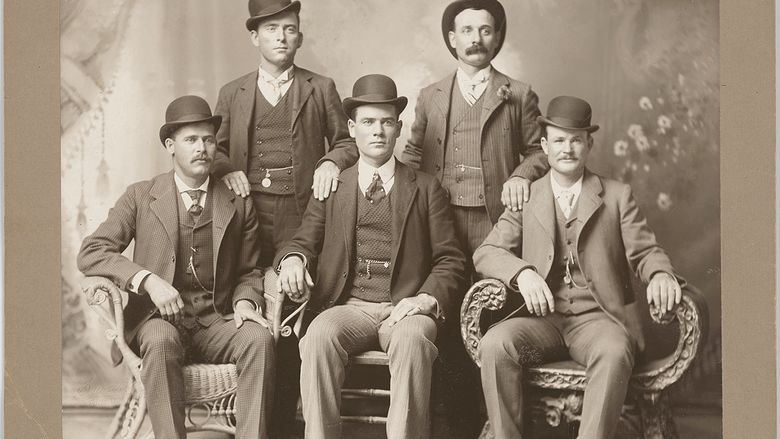
Ben Kilpatrick and the Fort Worth Five

ftworthfivesmithsonian

(Image credit: Smithsonian Institute)

This famous photograph, sometimes called the “Fort Worth Five,” was taken in 1900 an the Schwartz Studio in old downtown Fort Worth.  Pictured are the following: left to right, front row: Harry A. Longabaugh (aka the Sundance Kid), Ben Kilpatrick (aka the Tall Texan), Robert Leroy Parker (aka Butch Cassidy); standing: Will Carver and Harvey Logan (aka Kid Curry).  The photo is said to have helped authorities later to identify each of them and within twelve years, they would all be dead.  Carver was killed in a shootout in Sonora, Texas the following year.  Logan was killed in a shootout with a posse in Parachute, Colorado in 1904.  He may have taken his own life rather than submit to being captured.  Longabaugh and Parker are believed to have been killed in a shootout in Bolivia in 1908.  Kilpatrick died in 1912.

Continue reading Ben Kilpatrick and the Fort Worth Five

The Immortal Ten

On January 22, 1927, the Associated Press headline read “Basketball Team of Baylor Victim of Grade Crossing Tragedy Near Round Rock.”   The first reports indicated that of the twenty-one passengers comprised of players, coaches and guests, that there were as many as fourteen fatalities.  The exact number was ten: James Clyde “Abe” Kelly, William Winchester, W. E. Murray, Merle Dudley, Sam Dillow, Jack Castellaw, L. R. “Ivey” Foster, Bob Hailey, R. L. Hannah and James Walker.

Continue reading The Immortal Ten