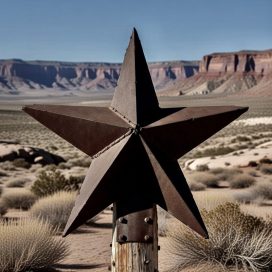
“Lonesome Dove” – the Miniseries

The miniseries filmed in 1988 was the first release of a series of video projects of the four “Lonesome Dove” related books written by author Larry McMurtry. In February of that year, press releases announced that filming would soon begin on the screenplay based on McMurtry’s Pulitzer Prize-winning novel that came out in 1985.

The Del Rio News-Herald in its issue of February 2, 1988 noted that locations would include the Moody family’s Rancho Rio Grande outside Del Rio and the Alamo Village in Brackettville. The miniseries was set to air for an estimated eight hours over several days. The article stated that the screenplay was written by Texan Bill Wittliff.

Named to participate in the project was veteran actor Robert Duvall with other casting to be named at a later date. The miniseries was to be a joint venture between CBS and Motown Production Company / Robert Halmi, Inc. The first filming was to be done in Bastrop, Texas before moving nearer Austin for more. Then the desert town, border crossing, river crossing and some of the cattle drive sequences were to be recorded near Del Rio on the Moody property and Brackettville, which stood in for early San Antonio. The set for the fictional town of Lonesome Dove was to be built on the Moody ranch which began around seven miles south of Del Rio. It was also noted that other sequences would be filmed around Santa Fe and several other sites in New Mexico, including pueblo locations. The New Mexico sites generally were used for the northern scenes. An article said that no scenes were filmed north of New Mexico. Filming was said to have taken just under 90 days from March until July, 1988.

The Moody ranch extended through parts of three Texas counties. It had been previously used for at least one film project. Just before the miniseries aired, a short article in the January 13, 1989 issue of the Waco Citizen told that the ranch furnished some of the cattle. It is also understood that the ranch supplied many of the remuda of horses seen in the episodes. The filming locations were in the United States governments tick quarantine zone. Another publication discussed the various tick eradication treatments that had to be used on the livestock during the filming.

Executives of the project were to include Dyson Lovell as producer, Suzanne de Passe (President of Motown’s film division) and Bill Wittliff as executive producers and Simon Winces as director. Basil Poledouris was engaged to score the music. The story line, as most people know by now, is the account of a fictional cattle drive from the banks of the Rio Grande to Montana.

Set in the late 19th century, the story follows two retired Texas Rangers who are inspired by another former ranger’s tales of the wide open spaces and life in Montana. The two put together a huge herd of cattle with a view to driving them the 2,500 miles. They assemble a diverse collection of cowhands to manage the herd. Along the way, they encounter various hardships of marauding attackers, native wildlife, insects, uncooperative weather, harsh terrain and other problems.

An article on April 24, 1988 in the same Del Rio newspaper bought readers up to date on the progress. The crew and cast had been filming for several weeks on the Moody ranch. Its dry and dusty climate fit the descriptions in the book: few if any trees, “brown land and gray chaparral” characterized by clear skies. It credited set designer, art designer and production designer Cary White for his artistry in clearing the site for the tiny town of Lonesome Dove. The set was built on the ranch’s property south of the confluence of Sycamore Creek and the Rio Grande.

The set for the town is seen in various views during the first episode and included about a dozen structures. A couple of buildings (the headquarters and at least one barn in serious need of a roof) along with with a corral or two comprise the structures of the Hat Creek Cattle Company business of Gus and Call. There is also the J. J. Pumphrey general store and a church and the two story Dry Bean saloon.

The article gave a profile of writer Bill Wittliff, listing some of his earlier work for the big screen. Duvall was cast as Augustus “Gus” McCrae while Tommy Lee Jones was cast as Woodrow F. Call. Duvall’s character has a great many lines in the book and now more than thirty-seven years later seemed a perfect choice for the part. The article mentions a sentiment by some at the time that perhaps Duvall might have been a good choice for the character Call after his performance in the film adaptation of Horton Foote’s “Tender Mercies,” but after so many years, it would be hard to imagine any other casting.

Also lauded is the choice of actor Robert Urich as the character Jake Spoon, Diane Lane as the “sporting woman” Lorena Wood and Angelica Huston as Clara Allen, portrayed as a strong female horse rancher and former love interest of Gus. Also mentioned is actor Danny Glover as the outfit’s wise and critically important guide on the journey.

Elsewhere in the April 24, 1988 issue, a call was made for fifty local people as extras for the project. The producers were looking for “ten Hispanic women with long hair, eight Hispanic children (both male and female, six years and up), ten Anglo women with long hair, twenty Anglo men and two Hispanic men.” These people would serve during the two days of Brackettville filming in early May. Applicants were to submit their information to the Texas Employment Commission (now called the Texas Workforce Commission) and that it should include their wardrobe sizes, a nonreturnable photo, positive identification such as a driver’s license, passport or birth certificate.

The miniseries aired on CBS for four evenings beginning February 5, 1989. The first episode drew an estimated audience of 44 million viewers making it the highest rated show on television for the week. It was awarded seven Primetime Emmy Awards out of its eighteen nominations. The following year it received a Golden Globe award for Best Miniseries or Motion Picture Made for Television.

The enduring miniseries is currently available on various streaming services.


Not quite a decade after the miniseries aired, the Del Rio News-Herald published an interesting article about a Japanese police officer who decided to come to Texas and visit the places he saw on the screen. Sergeant Masayuki Okazawa of Ibaraki, Japan inquired of the local Chamber of Commerce and Tourist and Convention Director Susan Cottle Leonard to see if such a tour might be possible. To help him prepare, he had learned enough textbook English to be able to converse a bit. While in Texas for a week, Sgt. Okazawa made stops in San Antonio and Fort Worth but his main goal was to see filming locations of “Lonesome Dove,” especially Clara’s orchard. The ranch made it possible. Sgt. Okazawa enjoyed meals with the cowhands during his tour. He especially enjoyed the location of the orchard, as he had been particularly moved by that part of the story. Sgt. Okazawa was able to return home with great memories from his trip.

© 2026, all rights reserved.

Tales of the Texas Rangers

“Tales of the Texas Rangers” refers to two programs which aired in media during the 1950s. The first was a radio program and the second was a television series.

The radio program: It was conceived as a weekly half-hour program to broadcast fictionalized stories pertaining to the former law enforcement agency. It was set in the 1880s and used scripts in a style that might be reminiscent of shows like “Dragnet.” Stacy Keach, father of actor Stacy Keach, Jr., was producer and director. Joel Murcott was the head writer of the series.

Continue reading Tales of the Texas Rangers

Don Williams, Country Vocalist

Donald Ray Williams was born in Floydada, Texas May 27, 1939 to James Andrew Williams and Loveta Mae Lambert Williams. His grandfather on the Williams side was Emory Rains Williams who was also the grandson of Emory Rains, namesake of Rains County. Don’s father was a carpenter and the family moved from time to time. Don was the youngest of three sons of James and Loveta Mae. By the time Don reached high school age, the parents had either separated or divorced. James remained in West Texas. Don was living with his mother in Portland, Texas where he graduated from Gregory-Portland High School in 1958.

Continue reading Don Williams, Country Vocalist

Brad Johnson, Actor

Brad William Johnson (1959 – 2022) was an American actor. His parents were Grove Johnson and Virginia Scala Johnson. Brad was born to the couple on October 24, 1959 while the family was living in Tucson, Arizona. It has been suggested that he graduated from high school in Dallas but most likely, he graduated in Grants Pass, Oregon. Online genealogy sources note that he was in the school yearbooks when he was in the 11th and 12th grade. Also, he appears to have attended but did not graduate from college.

Continue reading Brad Johnson, Actor

Texas Guinan

Mary Louise Cecilia Guinan (pronounced “guy-nan”) was born January 12, 1884 in Waco, McLennan County, Texas to Michael Guinan (1854 – 1935) and Bridget Cecile Duffy Guinan (1857 – 1939). Her nickname as a child was “Mamie” and she was the second of four children. Both of her parents were born in Canada and their ancestry is said to have been Irish. While living in Waco, the father was part owner of a wholesale grocery and candy business named Eagon, Guinan & Co. near downtown on Austin Street. Various articles note that she attended school at the Loretta Convent in downtown Waco. They likely lived in Waco until the early 1890s. By the time the 1900 federal census was taken, the family had relocated to Denver, Colorado. In 1900, Mary Louise was about 17 years old and was still living at home. The father’s business was listed as being the owner of a public warehouse. Her parents also owned a ranch at some point. She learned to ride horses and she was otherwise an active child. As she grew up, she studied singing and and would later be drawn to the entertainment business, including vaudeville. Along the way, as a reference to her birthplace, she began to adopt the nickname “Texas” and used it for the rest of her career.

Continue reading Texas Guinan