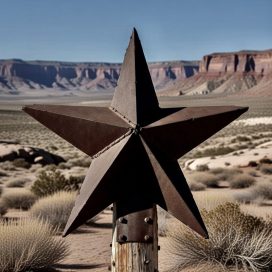
William A. A. “Bigfoot” Wallace lived from 1817-1899 and was a Texas Ranger, one of 30 to be inducted into the Texas Ranger Hall of Fame. He came to Texas after the death of his brother and a cousin at the hands of the Mexican Army at Goliad in 1836, intending to somehow even the score for his lost relatives. Wallace is believed to have many times exacted his revenge, though he was captured and imprisoned by the Mexican Army himself in the early days of 1843 in the so called “Black Bean Episode,” which he survived. Wallace is mentioned in many other historical accounts as he fought as a Ranger in the Mexican-American War, continued to serve as a Texas Ranger during the 1850s and beyond. He did not serve in the Civil War, electing instead to remain in Texas to guard the borders against Indians, renegades and Union soldiers. The young State of Texas benefited from an uneasy arrangement with the Confederate Army to allow some Rangers to remain in place to defend the frontier.
He received the nickname “Bigfoot” after he was mistakenly identified as a fugitive Indian known by the same nickname. He was briefly detained before being released, but the nickname still stuck with him.
Myth and reality seem to separate at this point. In his book I’ll Tell You a Tale, J. Frank Dobie relates the account of the capture and killing of a horse and cattle thief known only by the name of Vidal, who was wanted “dead or alive.” The story is told where “Bigfoot” Wallace joined fellow Ranger Creed Taylor and a rancher named Flores in pursuit of Vidal who had stolen some of Taylor’s horses, among others. Tracking the rustlers as far as the Frio River near Uvalde, they came upon the thief and two associates all of whom were sleeping. The Rangers surprised the outlaws and all of them were killed in the resulting gun battle. To Wallace was attributed the idea of making an example of Vidal, tying his severed head and sombrero to his saddle, lashing it all to the wildest mustang, slapping the nervous beast on the haunches and letting it go free, Vidal’s serape trailing in the wind.
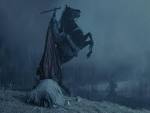
Thus was born the South Texas legend of El Muerto, Texas’ own “Sleepy Hollow” tale. Thereafter, there were numerous reports of a headless rider on a wild horse that haunted the plains. Eventually, a mustang bearing a shriveled corpse was captured near Ben Bolt (near Corpus Christi) and and the body was buried nearby, but the legend of El Muerto continued, with reports of a headless horseman being seen on clear, moonlit nights.
Whether or not the story is true or only a legend, it is one of the more intriguing tales to come from the period. Creed Taylor would live until 1906 and be buried in the Noxville Cemetery near Junction, Texas. As for Bigfoot Wallace, on January 8, 1899, the Houston Post carried the following report. “Captain “Bigfoot” Wallace died this morning at 10 o’clock after an illness of about one week. The immediate cause of death was pneumonia. Captain Wallace was a pioneer of this State, coming to Texas in 1837 for the express purpose of avenging the death of his brother, who was captured and slain by the Mexicans in 1836. His home was Lexington, Va. where his only living brother and other relatives now live. The captain was 82 years old when he died. About the last trip of the old veteran was upon the occasion of the Dallas fair last October. He was very feeble then and those who saw him realized with sorrow that the summons across the Great Divide was not to be long delayed.”
Ballad of Bigfoot Wallace
by Sloan Rogers
Gather all ye people, a story I will tell,
About a famous ranger, in Texas he did dwell.
Called Bigfoot Wallace to the end of his life,
He loved women and children, but never had a wife.
Bigfoot came to Texas in old republic days,
And with his trusty rifle served in many ways.
In every little skirmish and bloody battle ground,
There never was a tougher ranger found.
Riding into Austin in eighteen-thirty-nine,
Here he found a name, no one could malign.
Mistaken for an Indian in a dawn attack,
He took the chief’s name and never gave it back.
Texas was invaded in eighteen-forty-two,
So Bigfoot joined the rangers to get a better view.
They had a little battle east of San Antone,
Rangers sent that army running for its home.
Craving Texas vengeance for the invasion slight,
Rangers rode to Mier to give ’em another fight.
Captured and sentenced according to the law,
From a jar of beans all were forced to draw.
Bigfoot drew a white bean, while others drew the blacks,
They had another reason with the rifle cracks.
Swearing vows of vengeance for the martyred few,
This execution, there guards would one day rue.
Freed from Perote Castle in eighteen-forty-four,
Bigfoot and the rangers, now heroes of Texas lore.
Returning to their families and their hard fought lands,
Bigfoot and the Texans joined new ranger bands.
The message of this story is very clear to me,
Whether you’re a ranger or a wannabe.
Rangers are tough and rangers are true,
But Bigfoot was the toughest, Texas ever knew.
(Used with permission)
© 2015, all rights reserved.
 Texas History Notebook
One thought on “Bigfoot Wallace and the Bandito Vidal”
Comments are closed.