
The organization known as the Book Club of Texas was conceived in late 1928 and formally created in 1929. Its purpose was laid out by Stanley Marcus of Dallas in a newspaper interview carried by the Houston Chronicle in its issue of November 25, 1928 in the copy below. Marcus said “The Book Club of Texas has been formed for the purpose of fostering arts pertaining to the production of fine books. It will function in two ways: first, by the publication of books that will typify the best standards of bookmaking, in regard to object matter, printing, binding and typographical design; second, by sponsoring exhibitions and lectures pertinent to these interests.” Marcus went on to describe the governance, membership and benefits to those who participate. The entity was set up as a not for profit and non commercial group and began operating in early 1929.
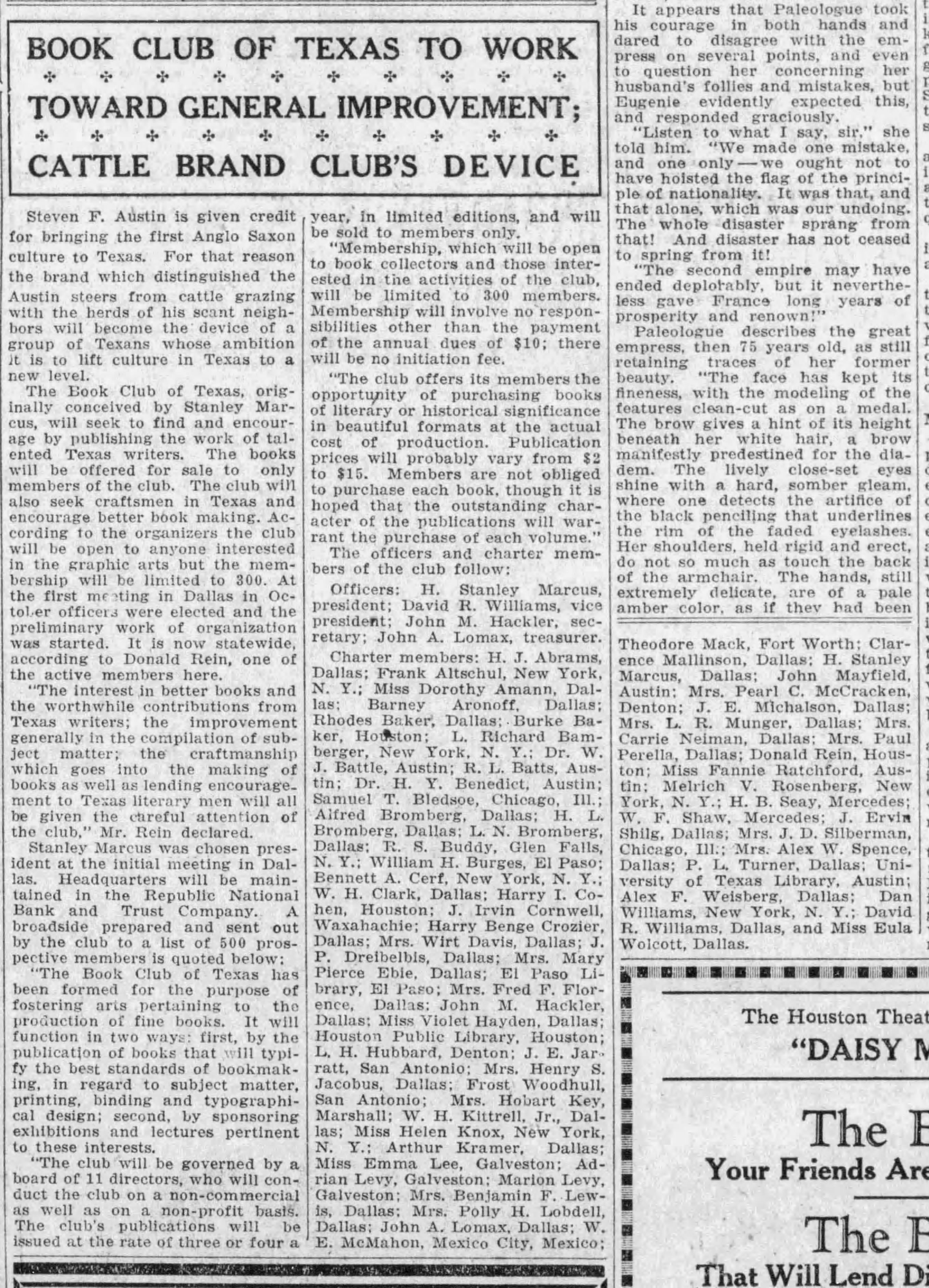
Charter members were from around the state, though many are from Dallas. Members would be invited to purchase books produced by the club, but would not be obligated to do so.
The listed organizers were a group of interesting people. It is not noted how they became acquainted though some would appear to have had connections through the University of Texas at Austin. The five listed were Marcus, John Avery Lomax, David R. Williams, Fannie E. Ratchford and John M. Hackler.
A few years earlier, Stanley Marcus (1905 – 2002) had joined the Neiman-Marcus family business founded by his parents Herbert and Minnie Marcus, his aunt Carrie Marcus Neiman and uncle Al Neiman. Stanley had recently graduated from Harvard and had already developed a love for literature and fine books. Marcus would become known as the primary family member who led the company into its success as a high end specialty retailer.
John A. Lomax Jr. (1907 – 1974) served as treasurer. Lomax was a Dallas banker, and was known as a folklorist, performer and investor. He was the son of John Avery Lomax Sr. and Bess Bauman Brown Lomax and was the brother of Alan Lomax, well known musician who with their father was instrumental in collecting and recording original American music. The Lomax family contributed greatly to the preservation of music and folklore in Texas.
David Reichard Williams (1891 – 1965) was a Dallas architect. He had a fascinating resume including having been born in a dugout cabin in West Texas. His father was listed as a boot and shoe maker in the 1900 census. David’s early work experience began with his doing construction and repair work for the Fort Worth and Denver City Railway. David studied architecture at University of Texas at Austin from 1912 to 1916 before accepting a position as an oil company engineer in Mexico. After more travels and work experience, he began working as an architect in the Dallas area in the mid 1920s, soon becoming known for his distinctive architectural designs. He also created the unique colophon, or logo, for the BCT organization, incorporating stylized cattle brands and a branding iron.
Fannie Elizabeth Ratchford (1887 – 1974) was born in Paint Rock, Texas. In the 1910 census her father was a county surveyor in Concho County. Fannie was one of the daughters living at home and she was teaching school. For many years she was the curator of University of Texas’ Wrenn Rare Book collection. Fannie became known for her expertise in the field of rare books and contributed her talents by selecting and editing projects for the organization.
John M. Hackler (1889 – 1953) earned his law degree from University of Texas at Austin in 1921 and came to join the Dallas law firm of Locke and Locke in 1923. Less is known about Mr. Hackler other than he incorporated the entity and practiced law in Dallas.
The concept was for the group to produce high quality books, making them available to members at a price as close to cost as possible. Membership was to be limited to 300 and annual dues were modest. The intent was to produce at least one book per year. These are the seven books that were produced by the club during its existence.
Memoir of Col. Ellis P. Bean – 1930 – Author: Ellis P. Bean (1783 – 1846). The author wrote his memoirs in 1816 about the early days of Texas at a time when it was under the control of Spain and before the Texas Revolution. This work was originally published as an addendum to an 1856 volume known as History of Texas, by Henderson Yoakum.
Eneas Africanus – 1930 – Author: Harry Stillwell Edwards. (1855 – 1938). A novel in the form of letters about an enslaved man who wanders about the south for eight years. First published in 1919, it is considered to be a romanticized, nostalgic and pro-slavery account of life in the 1800s.
Code Duello: Letters Concerning the Prentiss-Tucker Duel of 1842 – 1931 – Editor: Virginia Aylett Quitman McNealus. Centers around letters written between protagonists Mississippi Senator Sargeant S. Prentiss and Governor Tilghman M. Tucker. The exchange of letters dealt with conflicts between the two. Their disagreements were mediated by General John Anthony Quitman, grandfather of the editor. Themes include chivalry, etiquette, honor and the like .The conflict was resolved without actual shots being fired.
Miss Zilphia Gant – 1932 – Author: William Faulkner (1897 – 1962). The previously unpublished short story dealt with the life of the main character and tensions surrounding family relationships. Set in the author’s fictional location of Yoknapatawpha County, Mississippi which appears on other Faulkner works.
From Texas to Mexico and the Court of Maximilian in 1865 – 1933 – Author: Alexander Watkins Terrell (1827 – 1912). The author recounts events during the Mexican rule of Emperor Maximilian I. Deals with the experiences of former participants in the United States Civil War in Mexico after the French government installed Maximilian in an attempt to solidify its control of the area.
Tales of the Mustang – 1936 – Author: J. Frank Dobie (1888 – 1964). The author’s six essays about wild mustangs. A 1936 newspaper article said that the volume was released in connection with the Texas Centennial and noted the author’s preface stating “the Southwest owes more to the mustang than we have previously understood and that it will take a book to set the matter right.”
The Story of Champ d’Asile – 1937 – Translator: Donald Joseph, Editor: Fannie Ratchford. The story of Champ d’Asile (“Field of Asylum”), a briefly occupied settlement founded in Texas in January 1818 by veterans of the Napoleonic Wars. Land was offered to French settlers by the United States government. Champ d’Asile was situated along the Trinity River and was abandoned in July of the same year.
The book club survived the Great Depression, but around 1938 elected to wind down its operations. In 1941, all the remaining inventory of books were contributed to the Texas Folklore Society.
Some of the seven books produced are considered collector’s items. Many are still available from book dealers. In 1988, a new organization was created with the name “Book Club of Texas, Inc.” but it appears to be in no longer existence.
© 2025, all rights reserved.
 Texas History Notebook