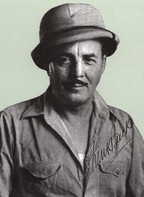
Frank Buck

frank_buck

(Image credit – findagrave.com)

Frank Howard Buck was born March 17, 1884 in Gainesville, Texas to Howard Dewitt and Ada J. Sites Buck.  By the time Frank was a teenager, his parents had moved to Dallas, Texas.  He attended school through the seventh grade and was not considered to be a particularly good student, perhaps because he had many other varied interests.  As a young adult he held a number of different jobs, including working as a cowboy.  He also is said to have traveled as a hobo for a while.  Buck moved to Chicago and began working at a hotel around 1900.  There he met and married his first wife, Lillie West, some 29 years his senior.

Continue reading Frank Buck

Doc Goodnight and the Goodnight Gang

The Goodnight Gang was a name given to a group of outlaws operating in East and Central Texas headed up by William E. “Doc” Goodnight.  Members of the group included Goodnight, Hugh Merrick, J. R. Willis and J. H. Johnson according to various newspaper accounts.  They were by reputation robbers and the crimes mostly attributed to them involved the theft of cash from local individuals.  There was a legend that William E. Goodnight was somehow related to rancher Charles Goodnight of North Texas, but we can find no obvious connection after looking into Charles Goodnight’s extended family.  Perhaps coincidentally, Charles Goodnight had a number of relatives in Illinois and the State of Illinois appears to also figure into Doc Goodnight’s early history.

Continue reading Doc Goodnight and the Goodnight Gang

Lt. Col. William E. Dyess

Lt. Col. William Edward “Ed” Dyess was born August 9, 1916 to Richard T. Dyess, a judge, and Hallie Graham-Dyess in Albany, Texas.  Dyess grew up working on the family farm and also held a number of odd jobs.  He was a Boy Scout, but had trouble attending meetings while he was also working.  The story is told of him that one week, a carnival had performed in Albany about the same time as he brought home a poor report card from school.  He is said to have told his parents that it was all right, he was going to join the carnival anyway when he got older.

Continue reading Lt. Col. William E. Dyess

Why Are The Karankawa Indians Remembered as Savage Cannibals?

By Tim Seiter

In 1767, Fray Gaspar José de Solís toured the faltering missions of Texas. When he visited the mission of Nuestra Señora del Rosario, which the Spanish built to convert the Karankawa Indians to Christianity, he wrote a lengthy report on their cannibalism in his journal: “Dancing and leaping and with sharp knives in their hands, they draw near to the victim, cut off a piece of their flesh, come to the fire and half roast it, and, within sight of the victim himself devour it most ravenously.”[1] Despite captivating readers for generations, Padre Solís’s account of the Karankawas’ cannibalism has a major problem—it is almost certainly fictitious. Although the Karankawas did, in fact, practice a rare exo-cannibalism, this disgruntled priest likely fabricated an exaggerated version of the custom. He has tarnished the image of the Karankawas for the past two-hundred and fifty years. This article explains why Fray Solis’s account, a source utilized by numerous scholars, should be used selectively and with caution.

Continue reading Why Are The Karankawa Indians Remembered as Savage Cannibals?

Ann Miller

Ann Miller was the stage name of Johnnie Lucille Collier, born April 12, 1923 in Chireno, Nacogdoches County, Texas.  Her father was John A. Collier, a criminal defense lawyer known for representing clients such as Baby Face Nelson, Machine Gun Kelly and the Barrow Gang. Her mother was the former Clara Emma Birdwell.  As a young girl, Johnnie suffered from rickets and took dance classes to help strengthen her legs.  She also studied piano and violin.  The family moved to Houston, Texas where she lived until she was nine years old.  Eventually her parents divorced and she moved with her mother to Los Angeles.

Continue reading Ann Miller