Abilene’s Jack Grimm was a successful independent oilman. He was born in Wagoner, Oklahoma to Suell Grimm (1883 – 1939) and Ida Mae Vermillion Grimm (1898 – 1979). He had one brother and several half siblings from Suell’s first marriage which had ended with the death of his first wife, Daisy in 1914. His father was referred to in census forms as being an interior decorator or a house painter. After his father died, his mother married Irwin Turnham (1886 – 1966).
Jack made his living and his fortune by drilling wildcat oilwells, which funded his imaginative passion for his many other adventures and discoveries. During his lifetime, he searched for the Loch Ness Monster, the remains of the Titanic, remnants of Noah’s Ark, the Big Bend’s legendary Big Bird and The Abominable Snowman. In a 1981 interview in the Abilene Reporter-News, Grimm attributed some of his desire for discoveries to his grandfather (probably a reference to his adopted grandfather Turnham), who told him stories of a buried treasure in a nearby Oklahoma creek. Jack took it upon himself to go exploring and search for the treasure and did so when he and a friend used dynamite to “excavate” the creek bank. They found no buried treasure but did discover Indian artifacts such as arrowheads, bullet fragments and what appeared to be the remnants of a battle long ago.
Jack served as a Marine during World War II as a demolition expert. During the war he became a friend of Bunker Hunt, oilman and one of the sons of H. L. Hunt. The two would later reconnect after the war ended. Grimm returned to his home state where he studied oil geology at the University of Oklahoma. It was there at the University that he met his future wife, a geology student from Abilene named Jacqueline E. Crain. The couple was married in 1947 and had two children.
After completing his work at University of Oklahoma, rather than take a job with an oil company, Jack elected to start out on his own in the oil business. His first well near Tulsa, Oklahoma was successful. The couple decided to relocate to West Texas to make their living there. They moved first to Breckenridge in 1951. In another interview, Grimm said that his next twenty-five wildcat wells were unsuccessful before he had another good one, but after that his luck improved. The couple moved to Abilene in 1955. His financial interests expanded to mining.
About 1970 he participated in his first quest, an expedition to search for Noah’s Ark, making the first of three trips to Turkey. The efforts were said to be unsuccessful, but Grimm returned with a fragment of wood that he later carried with him and always believed that the oak he dug out of Mount Ararat in Turkey was part of the biblical Ark.
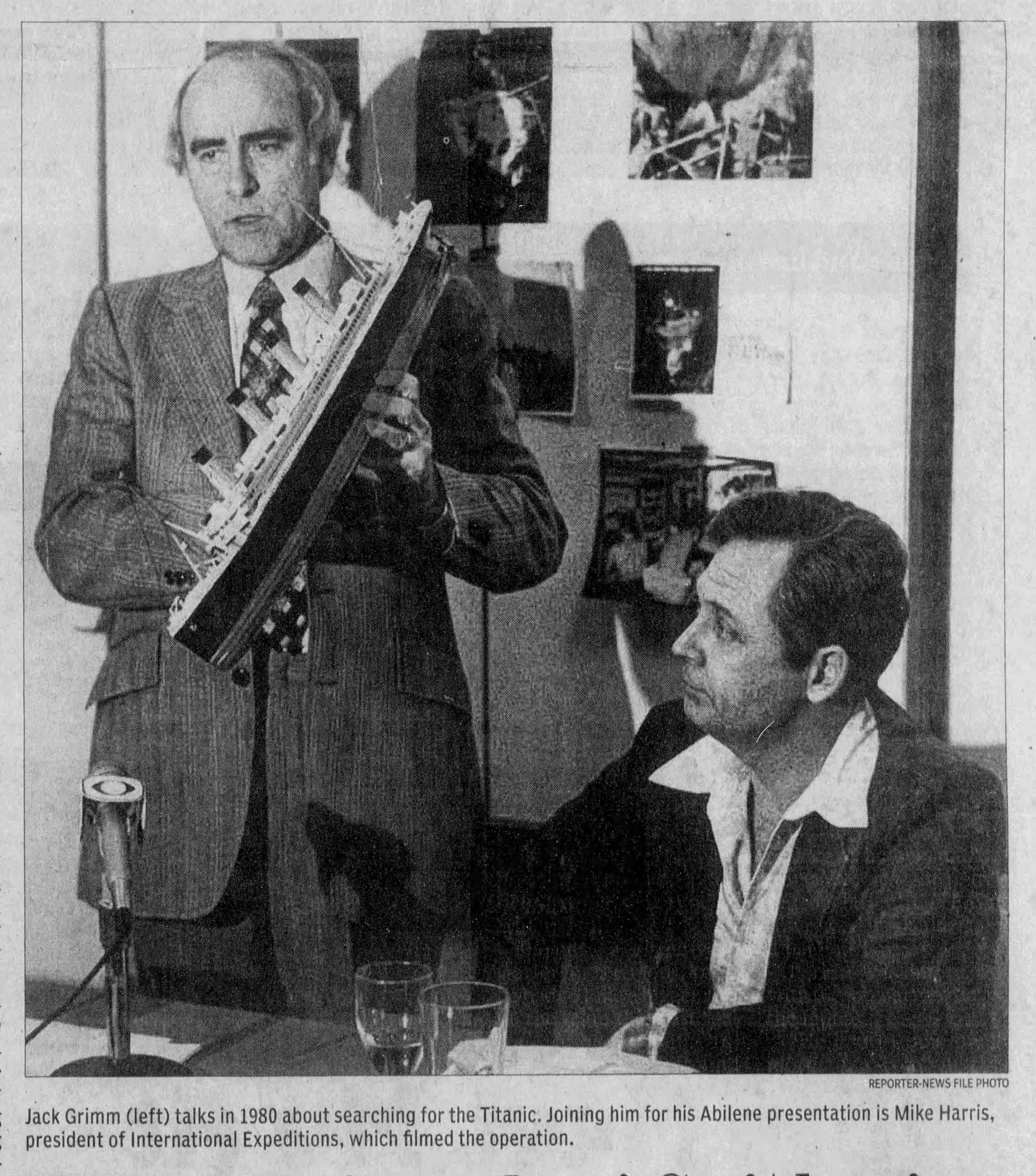
In 1979, Grimm was part of an effort to locate the sunken ocean liner Titanic, which by now most everyone would know sank in the Atlantic Ocean in 1912, even if they might not know the year it occurred. Though there were many survivors, some 1,500 lives were lost in the disaster. Another Abilene Reporter-News article from April 8, 2012 noted that Grimm’s interest in such an effort began when he was contacted by a Florida filmmaker named Michael Harris about searching for the ship. Grimm’s expeditions were well funded and staffed with scientists. Though it produced good results about the sea floor and the general location, actual credit for finding the Titanic was given to a later expedition in 1985 in which Grimm was not involved.
In 1983, Texas Monthly magazine sarcastically referred to Grimm’s Titanic quest when it awarded him a “Bum Steer” award for another Titanic-related event sponsored by Grimm, a treasure hunt of some kind. The winner was to receive a replica of the Titanic filled with gold coins. When asked about the dubious award, Grimm is known to have made light of it with his typical good humor.
One of Grimm’s last projects was closer to his home. Grimm lived just north of the town of Buffalo Gap, founded in the 1870s about thirteen miles southwest of Abilene. It got its name from a geographic feature, a split or gap in the low Callahan Divide that became a convenient passage for buffalo, native tribes and later buffalo hunters and settlers.
Grimm owned land there and at one time he had a small herd of bison. He had an ambitious idea to carve one side of the four hundred foot high gap in the mountain into a giant sculpture of a buffalo. A variant of the concept also involved carving the likeness of a political figure into the other side mountain. Bill Clinton, Ross Perot and others were considered. The project had been on Grimm’s mind for many years. He had first contacted nationally known sculptor Robert Berks in the early 1980s with his concept. Berks is known for his bust of President John F. Kennedy that is displayed in the Kennedy Center. The Texas project was to be forty feet high and two thousand feet long. A headline from 1981 read “Monument Will ‘Outlast Pyramids.'” Later, likely due to the cost, the project was scaled back and a more modest sculpture was proposed in the 1990s, engaging then Taylor County artist Rusty Hilbert. Though some blasting may have been done during one of the two efforts, the area appears now to have been reclaimed by natural growth.
Buffalo Gap still exists and has a historic village that includes its old jail and courthouse. There are modern structures and businesses as well. The view of the geographic features that led to its name is still much as it might have been one hundred fifty years ago.
Jack F. Grimm passed away January 6, 1998 at the age of seventy-two. His wife Jacqueline survived him until her own passing in 2003. Jack once said that he would like to be buried on his property in Buffalo Gap, but both are interred at a cemetery in Abilene.
© 2023, all rights reserved.
 Texas History Notebook