Winfield Scott was a well known cattleman, banker, cotton oil mill and cotton gin owner and real estate investor in Tarrant County. He was one of at least nine children born to Samuel Haden Scott (1792 – 1873) and Catherine G. De Graffenreid Scott (1811 – 1872) in Kentucky. His year of birth is sometimes shown as 1847 and other times shown as 1849. Like many people his age, one would only need to look back a few generations in his family lineage to find individuals who had served in the American Revolutionary War. His mother’s maiden name may be familiar to Texas people as well. Catherine De Graffenreid is from the same family as was Gaines De Graffenried. Gaines was known as a long time McLennan County resident and collector of Texas history artifacts. Although the spelling of their last name is slightly different, their family trees converge. There is no obvious relationship between this Scott family and that of General Winfield Mason Scott, the well known United States Army officer and presidential candidate.
An article in the Fort Worth Star-Telegram on October 27, 1911 (shortly after Scott had died) stated that he had earned his first money after arriving in Texas by working as a wood chopper along the Trinity River. It added that when Scott arrived in Texas, he could neither read nor write. He saved his money and with financial assistance from another family named Guinn, Scott was able to get his first start in the cattle business. An early land purchase was to acquire 160 acres in Tarrant County.
Scott was first married to the former Adelia Ann Colley (1856 – 1878) of Missouri in the 1870s. However, she died in 1878, the year their only daughter Georgia was born. Scott remained single for a number of years thereafter before being married to Elizabeth Simmons (1865 – 1938). Elizabeth and Winfield Scott had one son, also named Winfield Scott (1902 – 1956).
The same article in the Fort Worth Star-Telegram has Scott and an Irish partner organizing a cattle drive in 1872 from North Texas to Vinita, Oklahoma. It was a success and his share of the proceeds allowed him to begin to acquire property in Fort Worth. The article added that he was not so much a trader in real estate. He retained much of the property that he acquired.
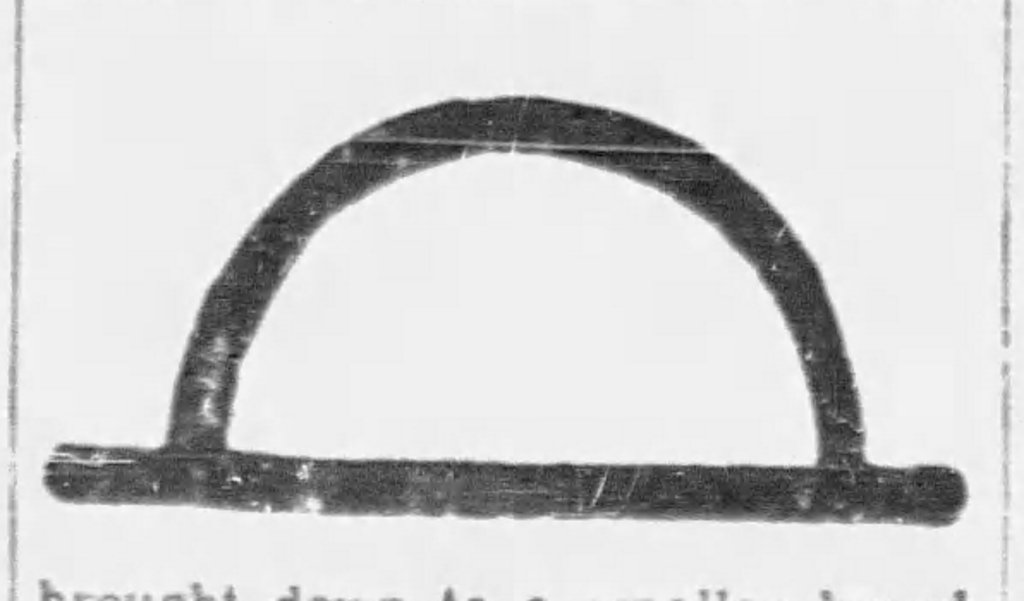
Though it is not always mentioned among his investments, for a number of years Scott had a major holding in a very large ranch in West Texas and the New Mexico Territory known as the Hat Ranch. He is believed to have been the majority owner in a two person partnership established in the early 1880s with Andrew Briggs “Sug” Robertson (1855-1921). One of the two variations of the Hat Ranch cattle brand is shown at the left. Image credit: John M. Hendrix in the Abilene Reporter-News.
Scott and Robertson created a ranching enterprise that extended from Mitchell County in Texas to what is now Lea County in New Mexico. The ranch amounted to as much as 1,000,000 acres at its peak. The real estate firm of Trammel & McCauley of Sweetwater, Texas completed the sale of the Hat Ranch in early April, 1907 by Messrs. Winfield Scott and A. B. Robertson. The price was undisclosed but was believed to have included acreage in Lynn, Lubbock, Crosby and Garza counties. Scott must have had a trusting relationship with Robertson. He named him as his executor.
Scott’s banking interests included the Texas State Bank, Fort Worth State Bank and the Fort Worth National Bank, the latter of which he was a director. Scott was also a major investor in the Mutual Cotton Oil Company of Fort Worth and the East St. Louis Cotton Seed Oil Company and was serving as president of these companies when he died. He was a director of the Protestant Sanitarium, a new hospital at that time. The entity was chartered in 1901 and the structure was completed that year at a cost of $25,000. It was located on Main Street at Vickery in Fort Worth.
Scott became well known in Fort Worth for his extensive real estate holdings. An amusing anecdote was recounted in the April 1, 1911 issue of the Fort Worth Star-Telegram. The Elks Minstrel company had referred to Scott with a long segment in their weekend act at the Byers opera house, a local venue. Quoting the newspaper article:
A friend of mine from the country visited me here a few months ago and I took him out to see the sights. Stopping in front of the Worth hotel, he said, ‘Fine hotel. Who owns that?’ I said, ‘Winfield Scott.’
We went down the street to the Metropolitan hotel. He admired that and asked who owned it. ‘Winfield Scott, I told him.’
Further on we ran into the Majestic hotel and he wanted to know the owner’s name and I had to tell him for the third time, ‘Winfield Scott.’
Getting near the passenger station, we stood fare to face with the Terminal hotel. He looked at it long and admiringly and asked who might own it. I was weary, but I said, ‘Winfield Scott.
I secured an automobile and took my friend for a ride. Coming to a farm, where grain was waving in the sunlight, he asked, ‘Who owns this lovely spot?’ and said, Winfield Scott.’
We came to a ranch. where lazy cattle browsed in meadow sweet. My friend asked who owned it, and I said, ‘Winfield Scott.’
We crossed the Trinity river and my friend commented on its beauty, casually inquiring who owned it. ‘The good Lord owns the Trinity.’ I responded piously.
‘The devil He does! How the deuce did it get by Winfield Scott?’ he replied.’
Fort Worth Star-Telegram, Saturday, April 1, 1911
The anecdote was humorous, but Scott did indeed own the Worth, Metropolitan, Terminal and Majestic hotels. He also owned a building occupied by Washer Brothers (a clothing store), a portion of the Scott-Harrold building and other properties in Fort Worth. Scott suffered from ill health for several years prior to his death and for the past month, he had been confined to his room. His situation continued to decline until he was moved to St. Joseph’s infirmary where he was operated on. Mr. Scott told his associates that he did not think he would survive very long and on October 26, 1911 he passed away. His wife, Elizabeth Simmons Scott, commissioned a mausoleum to be built at Oakwood Cemetery in Fort Worth. Mrs. Scott survived him another 26 years. She is also buried at Oakwood Cemetery along with her stepdaughter Georgia and their son Winfield.
© 2023, all rights reserved.
 Texas History Notebook