Billy Ray Klapper was born April 9, 1937 in Lazare, Texas, located a few miles west of Quanah in Hardeman County. His parents were Phillip Elbert and Minnie Helen Gooding Klapper. He was the third of five children, the others being sister Johnnie Fay, sister Dorothy Marie, brother Phillip Eugene and brother Joe Michael.
After high school in Quanah, Billy started working as a ranch hand. He first married Mildred Ann Hunter. That union ended in divorce some years later. In 1973 Billy married Roberta Lee Reed Watson to whom he was introduced by a mutual friend. One year after their marriage, his father Phillip died and after another year, his mother Minnie also passed away.
There were a number of pioneer spur makers in Texas. Two of them were J. O. Bass and P. M. Kelly. James Oscar “J. O.” Bass (1879 – 1950) came from Quitaque. He was an early blacksmith and began making bits and spurs for local cowboys. He later relocated to Tulia. His business gradually shifted away from general blacksmithing to the bit and spur business in response to increased demand. Bass was known for not using apprentices and doing all his own work, which he stamped or engraved with his name. The Kelly brothers, Pascal M. “P. M.” Kelly (1886 – 1976) and several siblings were also early craftsmen. The family started their business in San Antonio and relocated to El Paso in 1924. Their products are also signed in some fashion. Their bits and spurs might be considered somewhat less rare, perhaps because of their production methods and the larger volume of products that were sold.
Early in his working life, Billy made the acquaintance of spur maker Adolph Bayers (1912 – 1978), from the next generation of craftsmen. Bayers resided his whole life in and around Gilliland. He farmed and crafted bits and spurs. Some twenty-five years older than Billy when they met, Bayers was already recognized for making ranch products of his own design. Adolph had served in the United States Navy in World War II. As a sideline on his ship, he made knives which were much in demand by his fellow sailors. Bayers used a process of making his spurs out of one piece.
About 1966, Billy started making his own spurs and bits and began doing it full time a couple of years later. Roberta and Billy finally settled in Pampa where Billy built his own barn and shop. Articles and interviews can be found that show him making his spurs and bits from scratch. When he started out, like his mentor Bayer and others, his preferred raw material was Ford Model T or Model A car axles. This allowed him to make his spurs from a single piece of metal rather than welding them, since welded spurs might be considered more likely to fail under stress and use. As these car axles got more scarce and salvage dealers became aware of their value, he bought bars of steel. Billy would heat them up in his forge, put them in a vise and split them down the middle so that he could continue the practice of making products out of one piece of metal. Articles also mention that he used a forge that was coal fired but elsewhere in interviews Billy said that there was nothing better than to be able to smell the aroma of a wood fire.
There are videos of him that show various steps of his work. Billy talked about the old machines that were in his shop, such as grinders and polishers. Also, he spoke of how he had some of his tools hand made like the file he used for cutting the V shaped grooves on the rowel, the spinning wheel-like device on the back of the spur. He used silver solder which he said was more expensive, but reliable.
Billy kept records of his designs, and variations that might be requested by the buyers. His obituary stated that he created 682 different spur patterns and 816 unique bit patterns. He was responsive to his customers, working cowboys, and what they were looking to do with his devices.
Billy was said to have a great work ethic, working in his shop longer than he might have in an hourly paid job. In his prime, Billy could make 200 pairs of spurs a year in his Pampa workshop. Once his reputation spread by word of mouth, he always had a long backlog list of people who wanted his products. There is no way to estimate how many might have been bought by collectors, but presumably most were for working cowboys and were used until they needed to be replaced. He also was able to replicate antique designs and repair bits and spurs as needed.
A 1976 newspaper article in the Amarillo Daily News presented an interview of a local collector of saddles and other ranch equipment. Less than ten years after Billy had begun selling his work, his spurs were mentioned by the collector. A 1981 article in the Seymour Baylor County Banner carried an interview of Clarendon spur maker Melton McCowen in which he credited Billy as his mentor. One of the last newspaper articles to discuss him was in the March 2, 2000 issue of the Alpine Sul Ross Skyline. Billy was scheduled to appear later that week at a poetry gathering in town. Billy joined spur makers Gene Klein, Jerry Cates and Rick Crow who were to speak at an afternoon spur making session. The event was the program of the upcoming 14th annual Texas Cowboy Poetry Gathering.
After making his last set of spurs in the summer, Billy died in Pampa on September 10, 2024 at the age of 87. His funeral took place at a local church a few days later. A longtime friend spoke and recounted stories from Billy’s life. One was when one of his daughters wanted to ride their Shetland pony when she was four years old. Billy lifted her up on the pony. She remembered that she was soon bucked off and that Billy helped her get up, dust off and get back on the pony. Other stories mentioned his honesty and integrity, his love for Roberta and his family. He and Roberta were married for 48 years until her death in 2021. The speaker, Johnny Trotter, mentioned that early on Billy used to sell a pair of his spurs for $35 dollars and after some time, he apologized for having to increase his price to $55 dollars. He also mentioned that in 2014, Billy made a pair of spurs for a charity auction and that Billy seemed a bit surprised that they brought $27,000. He also noted how much Roberta and Billy enjoyed horse racing contests and that they were pictured in the photos of the winner’s circle when Ochoa won the All American Futurity in 2011 at Ruidoso Downs.
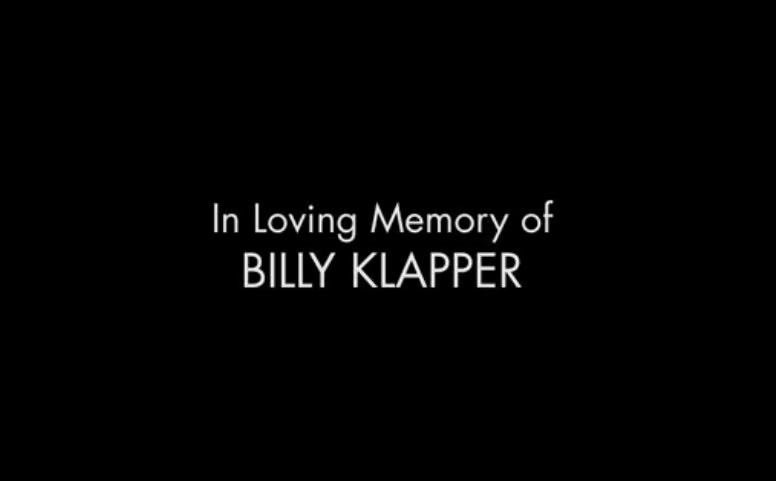
Billy’s honors included being named Spur Maker of the Year in 1998 by the Academy of Western Artists. He was posthumously inducted into the Texas Cowboy Hall of Fame in 2025. He also appeared in a brief scene in the series “Yellowstone.” In the two minute segment of the episode that aired November, 2024, a main character is asked to drive through Pampa, stop by Billy’s and pick up a “27 bit” for another cowboy in the show. The main character arrives to find Billy working in the shop. Billy locates the bit that was ordered and they exchange a few more lines. The scene ends on a very warm note. The closing credits for the episode acknowledge Billy’s memory. Rest in peace, Billy Klapper.
© 2025, all rights reserved.
 Texas History Notebook