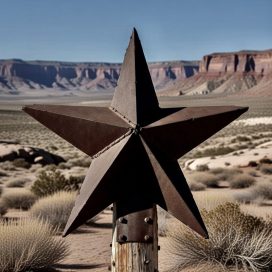
Little is actually known about the personal life of Ranger George R. “Red” Bingham. His date of death is July 3, 1880. A member of Company D under Captain D. W. Roberts, Bingham died in a gun battle in far West Texas. He is said to have been about 28 years old. His story is intertwined with that of an outlaw named Jesse Evans. In those days, most Texas Rangers were single men, which was most likely a requirement for employment at that time. Bingham was among a group of five rangers who were tasked with locating and arresting a group of outlaws believed to hide out in the area south of the territory of New Mexico and southwest of Fort Davis, Texas. Bingham was killed in a gun battle with the outlaws on July 3, 1880.
Jesse Evans is a well known outlaw’s name in New Mexico and Texas history. He is mentioned in accounts of the Lincoln County War. Before and after that he is generally referred to as an outlaw although from time to time he worked as a cowboy on western ranches. At various times, his path is said to have crossed with controversial characters such as Billy the Kid, John Selman and others. The exact nature and facts surrounding his eventual end are uncertain. These stories include him being killed in the gun battle where Bingham died. He was also reportedly captured, tried and sentenced to prison. It is also suspected by some that he changed his name, lived a law abiding life from that point and died quietly in another part of the country, perhaps the state of Florida.
Accounts of the incident in which Bingham died seem to vary somewhat as to the exact details, but Bingham’s death and the death of one of the outlaws is certain. A reward of $500 had been offered by local citizens for the capture of the Evans gang.
As told by newspaper columnist E. F. Eckhardt, around 1879 Evans and his associates were suspected of having committed robberies of stores and individuals in the vicinity of Fort Davis. A group of Texas Rangers, then known as the Frontier Battalion, were assigned to try to locate and subdue Evans and his gang. In a confrontation with Evans and his gang in the summer of 1880, the rangers included L. B. Caruthers, Sam Henry, Ed Seiker, Tom Carson and George “Red” Bingham. They were sent to the Fort Davis area to look for a group of four men including Evans in an effort to stop the robberies. A citizen had tipped off the lawmen that the outlaws sere working out of a hideout in the Chinati mountains. The rangers headed toward the Rio Grande border. When they were several day’s ride south of Fort Davis they caught sight of a group of four riders above them in the mountains. They headed toward the riders only to be fired on by the group. The rangers saw the suspects dig in on top of a flat topped mountain and exchanged fire with them. Bingham took a bullet to the heart early in the engagement. One of the outlaws was fatally shot by Ranger Seiker. The outlaw had hidden behind a natural ledge, but he raised his head to fire again only to catch a bullet from Seiker’s rifle. The rangers managed to flank the three surviving outlaws who realized their situation was hopeless and surrendered. Bingham, fatally wounded, was buried at the scene. The body of the dead outlaw, presumed to be Evans, was left to lie in the elements. Was it Evans? Maybe, or perhaps not. It was never confirmed. [Seguin Gazette, Seguin, Texas. December 19, 2010.]
Columnist Bill Armstrong in the November 5, 2007 issue of the Gallup Independent, Gallup, New Mexico wrote in passing of the shootout in which Bingham was killed. He introduced Evans to his readers as a person whose early history was only slightly less murky than his end, whatever it may have been. Armstrong says that Evans was said to have been born in Missouri around 1853 but that Evans at times had claimed to be a native Texan from the Fort Davis area. The writer gives a long account of the Lincoln County War. In that situation, he notes, Billy the Kid and Evans were on opposite sides of the conflict (although they may have worked in concert on other occasions). In the Lincoln County conflict, Evans was a gunman for the establishment Murphy-Dolan faction whereas Billy the Kid was a hired gunman for the Regulators, the opposition. The Lincoln County War, though relatively short, has been the subject of many books and articles. Writer Armstrong says as the Lincoln County issues died down, the Evans group moved on. They had been accused of stealing horses in Pecos County, Texas in the late spring of 1879. In Armstrong’s account, this was the charge that lead to the Texas Ranger interest and the shootout in which Bingham was killed. Armstrong said that Evans was captured, tried and sentenced to prison at Huntsville but that he escaped three years later, never to be heard from again.
Another account was written by Richard Rios of the Big Bend Sentinel, Marfa, Texas in its issue of April 10, 1975. Rios describes the Evans gang as robbers and cites that Company E of the rangers were called in after a robbery netting $1,100 of a store in Fort Davis. He calls Evans “one of Billy the Kid’s men” who had split off from the Kid after an argument. He notes the location as being near Alamito Creek which flows into the Rio Grande. If the shootout took place there, it would put it very close to the Rio Grande, roughly 25 miles to the southwest of Marfa and very close to Ojanaga, Mexico. Rios says that the rangers started toward the outlaws and ordered them to stop. Instead, the outlaws fired on the lawmen. He identifies the dead outlaw as one George Davis and those who surrendered as Evans, John Cross and Bud Davis and added that the bodies of Bingham and the dead outlaw were taken to Presidio where they were buried on July 4, 1880.
George “Red” Bingham may have initially been interred at the site of the battle, but he is buried in a small cemetery known as Pioneer Cemetery in Marfa. The name of either parent nor any other family member is not currently available. Ranger Bingham had been in service in Company D since the late summer of 1878. Documents from his service indicate that his monthly pay was about $1 per day.
© 2025, all rights reserved.
 Texas History Notebook