Jesse Robinson was born in Kentucky on February 11, 1800 to Charles Michael Robinson and Nancy Wood (or possibly Jannet Ray Robinson, as genealogy records differ). Jesse Robinson is rarely mentioned without reference to his first wife, Sally Newman, more famously known as Sally Scull, or Skull.
The date that Jesse came to Texas is still somewhat unsettled. Some accounts have him coming to Texas in 1822. He is not considered to be one of the “Old 300” of Austin Colony, but is believed to have been a member of the colony’s volunteer militia, considered to be the genesis organization for the Texas Rangers. Favoring this account, one of the families of Austin Colony was headed up by Joseph Newman, Sally’s father. In 1824, militia members including Robinson are said to have rescued the Newmans and a related family named Rabb from an Indian raid. Sally would have been a child at that time, but the stories suggest that this may have been how the Robinson and the Newmans met. In other accounts, he is said to be a member of the DeWitt Colony who arrived a few years later in 1827.
Robinson and Sarah Jane (Sally) Newman were married in late 1833. The couple had two children who lived to be adults, a daughter and a son, and possibly two more children who died in infancy. Sally and Jesse were later divorced in 1847.
Robinson received at least two land grants in the 1830s, the first of which was in DeWitt’s colony and was located on the San Marcus River north of Gonzales. He served in the Texas army in late 1835 and 1836. He is mentioned as participating in the Battle of Concepcion through the Battle of San Jacinto. Robinson has a biographical page on the website of the San Jacinto Museum of the Battlefield. In addition, Robinson took part in other events connected to the Texas Revolution including the pursuit of the retreating Mexican army under General Woll after Woll’s attempted invasion in the early fall of 1842. After the conflicts with Mexico finally died down, Robinson settled in Live Oak County. Some accounts have him being married to an Elizabeth Ann McFarlin but little is known of her. No children appear to have been born to any union of the two and they do not appear to have been married very long.
Federal census records are as follows. In 1850, he was living in Lavaca County with his two children by Sally. In 1860, Jesse was a member of the household of his son Alfred and living in Live Oak County. In 1880, at 80 years of age, he was living with the very large family of Alfred still in Live Oak County. Jesse died in December of 1882 and is buried in Latham Cemetery in George West, Texas.
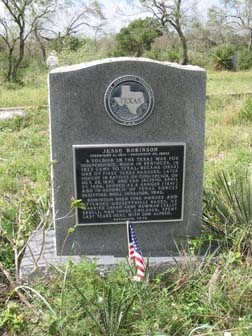
A Texas historical marker was established for Robinson and was installed in 1973 at the Latham Cemetery with the following text, “A soldier in the Texas War for Independence. Born in Kentucky, in 1822 came to Texas. Became (1823) one of first Texas Rangers. Later fought in battles of Concepcion, on October 28, 1835, and San Jacinto, April 21, 1836. Served as a Ranger (1841) and in Republic of Texas forces resisting Woll invasion, 1842. Robinson bred fine horses and attended Gussettville races. He married Sarah Jane Newman (Sally Skull). Had three children, spent last years here, with son Alfred.” 1973. (Image credit: Findagrave)
The stories and legends that involve Sally Newman are quite colorful. Normally they focus on her five marriages, her independent and pugnacious nature and legends about her final end. She was born in 1817 in Illinois to Joseph Austin Newman and Rachel Elizabeth Rabb. Her family came to Texas as part of the Austin Colony. “Austin” was a Newman family name and some accounts say that the Newman family were cousins to the Moses Austin family, although they do not appear to be closely related.
Her husbands were Robinson, George Scull, John Doyle, Isaiah Wadkins and Christopher Horsdorff. A few days after her 1843 divorce from Robinson, she married George Scull. Scull was supposedly a survivor of the Goliad massacre. Scull was not his birth name but he adopted it after surviving a serious head wound. Scull was a gunsmith by trade. They lived for a while on a ranch owned by one or both of them near Goliad. Scull disappeared after they had been married about six years. There were various stories about how he had been killed by Indians or that he had left her while on a horse trading trip, but he was out of her life at some point. For a while thereafter, she continued to use his last name but adopted the spelling “Skull.” She settled for a time in Banquete, Texas in Nueces County. In 1852 she was married for a short while to John Doyle who also disappeared later. Her fourth husband was Isaiah Wadkins whom she married in 1855. The story about Wadkins is that she divorced him a few years later after he left her for another woman. Her last marriage was to Horsdorff. By then it was around 1860.
Sally was said to have operated several businesses. She was in the horse business and had driven mule teams. During the Civil War she made her living by hauling and selling cotton for the Confederacy. Her horse brand was the Circle S. She had a reputation of being intense, quick tempered and fluent in foul language. She was rumored to have possibly killed one or more of her missing husbands, although she was never charged with such a crime. She was also rumored to have stolen horses. Sally was an expert horsewoman and was known to be a good shot with her rifle or one of the two pistols she often wore.
She lived many different places in Texas. Often her travels took her south of the border. On one occasion, she was allegedly captured and imprisoned by Mexican activist Juan Cortina. Her legend was enhanced by the story that she was released after winning a poker hand against Cortina who was amused and intrigued by her unconventional personality and behavior. Another anecdote has her losing a team of mules in a Nueces River flood. Scull is said to have remarked that she would rather have lost the best husband she ever had than to lose “them good mules.”
Sally was not heard of after about 1866. There are alternative legends about her death or disappearance as well. One was that her last husband or someone else had killed her for the money she carried with her. Another was that she had changed her name, relocated to another location in Texas and lived to an old age.
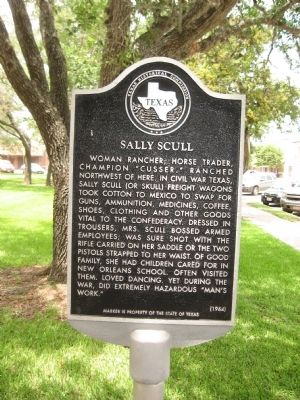
There is a historical marker for her, as well, installed in Refugio, Texas. Its text is as follows, “Woman rancher, horse trader, champion ‘cusser.’ Ranched NW of here. In Civil War Texas, Sally Scull (or Skull) freight wagons took cotton to Mexico to swap for guns, ammunition, medicine, coffee, shoes, clothing and other goods vital to the Confederacy. Dressed in trousers, Mrs. Scull bossed armed employees; was sure shot with the rifle carried on her saddle or the two pistols strapped to her waist. Of good family, she had children cared for in New Orleans school. Often visited them. Loved dancing. Yet during the war, did extremely hazardous ‘man’s work.'” (Image credit: Historical Marker Database)
© 2026, all rights reserved.

