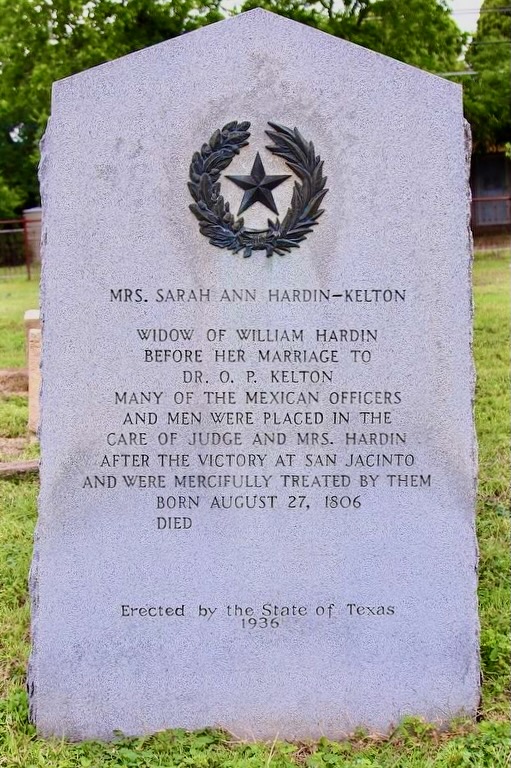
There is a Texas Centennial historical marker honoring Sarah Hardin-Kelton. The text is spare and states, “Widow of William Hardin before her marriage to Dr. O. P. Kelton. Many of the Mexican officers and men were placed in the care of Judge and Mrs. Hardin after the victory at San Jacinto and were mercifully treated by them. Born August 27, 1806. Died.” (Punctuation added.) The marker is placed in South Belton Cemetery in Bell County, Texas. Her date of death was not entered on the marker and still appears to be unknown at this time.
Sarah Ann Looney was born on August 27, 1806 to Robert Looney and Rebecca Kyle Looney in Kentucky, according to genealogy records. She was the youngest of their ten children. Her father was a veteran of the Revolutionary War and at least one older brother had served in the War of 1812. Apart from her family relationships, little is documented about Sarah’s early life.
Her first husband was William Bledsoe Hardin. He was born in Georgia in March of 1801 and died while still a fairly young man in Galveston during a yellow fever outbreak in 1839. Family accounts describe Hardin as a lawyer, newspaper editor and early settler of Tennessee. Hardin came to the area that became Texas approximately when Spain was yielding the area to the control of Mexico, probably in the mid 1820s. It is assumed that Sarah and William were married around 1830, although the exact date and location of the wedding is unknown. Some accounts set the year as 1929 and its location to be in Texas. It was the first marriage for Sarah and the second for William. He and Sarah had two children, William Joseph Hardin (born in 1831) and Jane Ophelia Hardin (born in 1833). William and Sarah settled in Liberty County, Texas. He served in various capacities including a position as local judge in the Anahuac area during the Anahuac Disturbances. William also was an early investor in land. Real estate records still refer to the William B. Hardin Survey in legal descriptions.
The stories of the Hardin’s compassionate treatment of Mexican prisoners after the battle of San Jacinto came to light prior to the Texas Centennial. The July 16, 1916 issue of the San Antonio Light posted an excerpt from a book by author and former Texas Ranger Andrew Jackson Sowell who wrote several books on early Texas history. This particular article begins with the defeat of Santa Anna. The rest of it appears to be based upon the account of Colonel Pedro Delgado. It was said of Delgado that no Mexican was more bitter toward the Texans than he. Delgado was a member of the staff of Santa Anna. Delgado’s bias has been noted in other articles. Although he was generally uncomplimentary about his treatment as a prisoner, he praised Judge and Mrs. William Hardin for easing the misery of the Mexican captives. Despite the elements of truth included in Delgado’s comments, it is fair to say that they are not tempered in any way by the recognition of Santa Anna’s well known cruelty to Texian prisoners on numerous occasions following his victories.
Delgado notes that General Martín Perfecto de Cos, brother in law of Santa Anna, was the highest ranking prisoner to visit them. Delgado referred to the Texian commandant, Morgan, as “a harsh and rough man” but one who nevertheless became somewhat attached to Cos. The prisoners were first housed on Galveston Island for several months until their transfer to Anahuac and then to Liberty in the middle of August. Upon their arrival, they were allowed to camp in a grove of trees on the property of the Hardins. That portion of his property became known as “Mexican Hill.” Food and water were plentiful at first, but supplies eventually dwindled. Prisoners received assistance for a while through the efforts of Don Francisco Pizzaro Martinez, Mexican consul at New Orleans. They suffered again towards the end of the year 1836. Some died due to illness.
Delgado made note that Judge Hardin had brought in medicine and medical assistance as needed. He added that Hardin listened to them and was patient with them. He also pointed out that Hardin had a frame house built for them at his own expense to shelter them from the elements by the time winter arrived. Hardin continued to secure rations of meat and salt and from time to time, he would kill and dress a beef for them. Delgado personally acknowledged Mrs. Hardin for furnishing the prisoners with bacon, seasoned beef, coffee, sugar, bread and other food items even to the point that it created hardship for her own family. She also was said to have furnished beds for the sick.
The citizens of Liberty held a ball the following April 21 to celebrate the anniversary of the battle. Delgado commented that the prisoners were fearful of some kind of reprisal from the residents of Liberty, but that no such event had transpired. Delgado, presumably being quoted in the article, also claimed that in the 1836 battle, “so many illustrious Mexicans were immolated,” something that to our knowledge never happened. The prisoners soon received the good news that they were going to be released and that happened in late April, 1837.
As noted above, Hardin succumbed to yellow fever in Galveston on June 28, 1839. To honor his last request, William’s remains were returned to Liberty for his funeral and burial in a family plot on his farm. A separate historical marker was created for him there.
One year after William’s death, Sarah married Dr. Oliver P. Kelton. He had been born in 1814 in South Carolina and had moved to Texas when he was around 21 years old, as the Texas Revolution was ramping up. He served as a surgeon in the Texas Navy aboard a schooner. Dr. Kelton was also noted as having attended to Santa Anna after his capture and confinement. A few months after the San Jacinto battle, Kelton formally announced that he was opening his medical office in Columbia. He was granted about 1,500 acres of land for his service during the Revolution. He also acquired real estate in Houston in the Buffalo Bayou area. As a result, his name appears in many legal notices.
It was the first marriage for Dr. Kelton. Sarah was about eight years older. Their immediate family included Sarah’s two children by William Hardin. Sarah and Dr. Kelton had one son, Mark Anthony Kelton, in 1842. Soon after statehood, Dr. Kelton unsuccessfully ran for a seat in the Texas Congress. Near the end of that decade, Dr. Kelton appears to have suffered from a mental decline and died soon afterward in an institution in New York. Mrs. Kelton moved to the Waco-Belton area with her children in the 1850s. Sarah is listed as being 54 years old in the 1860 census, residing in Belton with her sons Joe Hardin and Mark Kelton and grandson William Hardin. Her exact date of death is unknown, as noted, but it is believed to have been after 1860.
© 2026, all rights reserved.

