Samuel Rhoads Fisher was born on December 31, 1794 in Philadelphia, Pennsylvania to Samuel Wharton Fisher and Elizabeth Rhoads Fisher, a family with Quaker ties. He resided for a number of years in Philadelphia. Fisher was married to the former Ann Pleasants on September 2, 1818. Children of the couple include Samuel W. born in 1819 in Missouri, Ann Nancy Fisher born in Philadelphia in 1823 followed by Samuel R. Fisher, Jr. born in Texas in 1833.
According to a family biography, one of Fisher’s early jobs was to serve as a civilian governmental employee in the Philadelphia naval stores, a supply agency for the Navy. His work habits and discipline earned him a promotion as “commisariat,” a leadership position. He and his family later moved to New Jersey about 1825 before emigrating to Texas.
Fisher became acquainted with empresario Stephen F. Austin. A biographical sketch of Fisher notes that he had initiated correspondence with Austin in the summer of 1830 about the political situation, the economic situation, slavery and other issues. The so-called Bustamante Decree had been passed a few months prior. Mexican President Anastacio Bustamante had signed a decree with several provisions viewed as negative to Anglo immigration: limiting immigration from the United States, outlawing the importation of slaves, placing of taxes and duties on goods entering Mexico from the United States, increasing military presence, cancellation of unfulfilled empresario contracts. Fisher and Austin are believed to have continued their correspondence over a number of months. The exchanges satisfied Fisher and he, his wife and oldest two children moved to Texas around 1831. They were part of Austin’s Third Colony in Mexican Texas. Founded in 1827, headquarters of the colony were in what is now Bastrop but Fisher’s grant was located on the Gulf Coast in Matagorda County.
The Fishers settled in Matagorda. He was described as a planter and a merchant. He served as alcalde (like a judge or mayor) beginning in 1833. He also was involved in shipping and is believed to have owned or had an interest in several schooners.
Fisher was said to be a supporter of Austin’s candidacy to serve as the first president of the Republic of Texas. Sam Houston overwhelmingly defeated Austin, but Houston appointed Austin to serve as Secretary of State of the new Republic. Houston was known to make appointments intended to unite some of the political factions in the Republic. In October 1836, upon recommendations, Houston appointed Fisher to be Secretary of the Navy in acknowledgement of Fisher’s maritime background. Fisher was a civilian volunteer during the months preceding the Texas Revolution.
The Hannah Elizabeth: Individuals had chartered the six year old Hannah Elizabeth in an effort to bring munitions and other supplies to benefit the Texas Army. The William Robbins was a privateer though she was later acquired by the Republic and renamed. According to old accounts, Hannah Elizabeth was being pursued around December 19, 1835 by the Mexican ship Bravo when Hannah Elizabeth ran aground trying to reach the relative safety of Matagorda Bay. The crew was able to toss some or all of the cargo overboard before she was overtaken by the crew of the Bravo. Forces aboard the 60 ton William Robbins overpowered the Bravo‘s crew to retake the ship, though Hannah Elizabeth was so damaged that she soon broke up. Some of the cargo was salvaged and sold at auction, which did not sit well with certain of the Texas officials including James W. Fannin, Jr. The William Robbins was acquired at a cost of $3,500 by the Republic in early January, 1836 and became the first vessel of the Texas Navy, recommissioned as Liberty. The provisional Texas government had authorized the creation of the Navy a few weeks prior to the Hannah Elizabeth events. The initial fleet was to consist of four vessels.
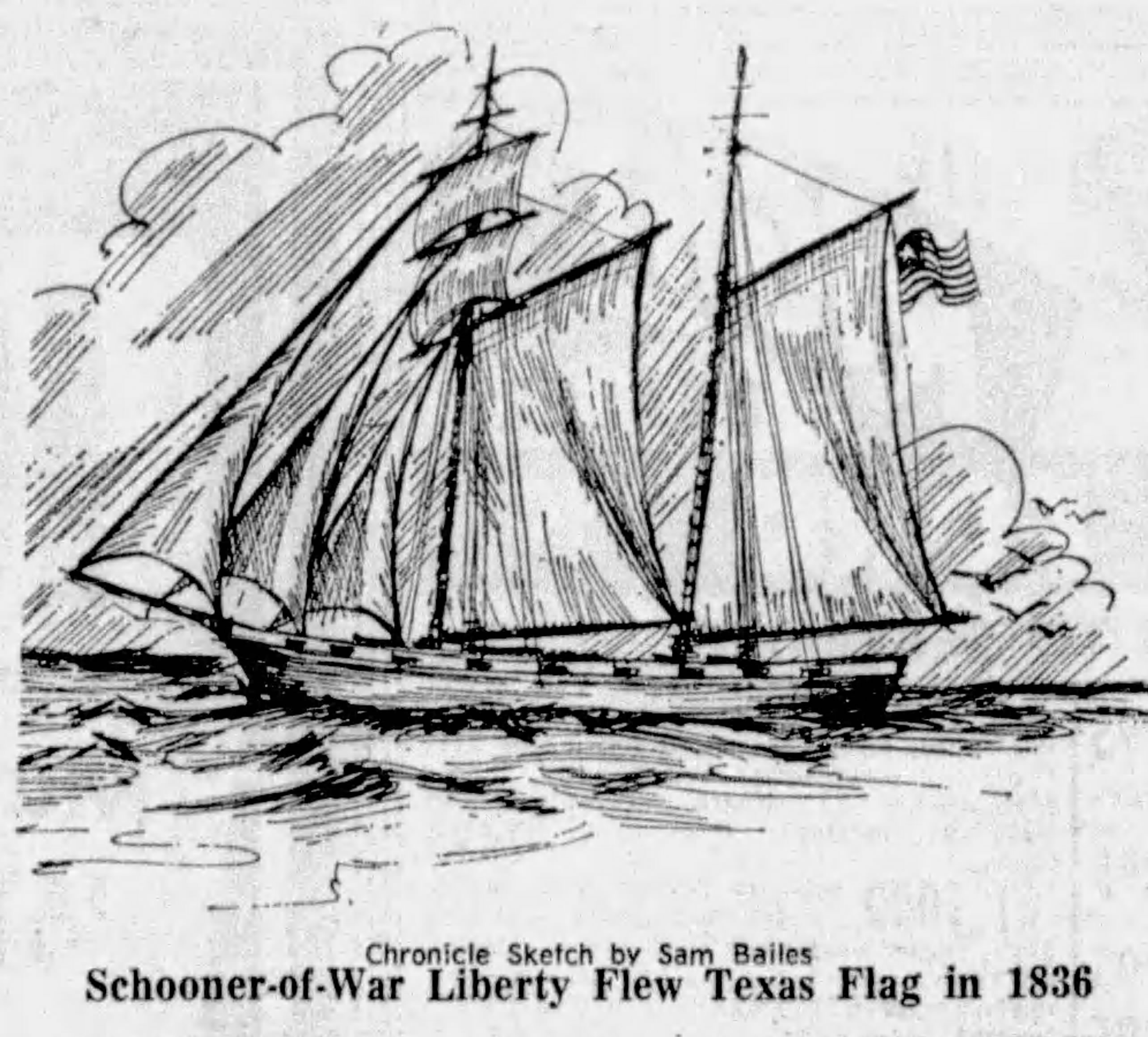
Though Liberty was the only ship for a while, it was successful in some other action and is believed to have required Mexican General Santa Anna to alter the logistics of how supplies were brought into Texas.
Fisher was a delegate representing Matagorda at the Convention of 1836 and as such was a signer to the Texas Declaration of Independence. His election to serve as a delegate was controversial. Fisher had received less than the number of votes received by another candidate, but on review of the results, some votes for the other candidate were disallowed for technical reasons including possible nonresidents having cast ballots in the other candidate’s favor. Fisher was declared the winner. Fisher was among a handful of delegates who arrived late. He had been delayed a few days while attending to his young daughter’s illness with scarlet fever. Fisher and others were seated and duly permitted to sign the Declaration of Independence. Fisher also signed the Texas Constitution that was adopted at that same convention.
The next ships brought into the Texas Navy were Independence, Brutus and Invincible. A timeline of the history of the Texas Navy notes that from the fall of 1836 and late summer of 1837 the three were involved in battles. However, over a little more than a year, each ship in the fleet was lost. Liberty was the first, being forfeited in a Louisiana shipyard in July, 1838. The Republic could not pay for the cost of necessary repairs. Independence was captured by the Mexican Navy in April of 1837. Brutus and Invincible carried out raids off the coast of Mexico but were both destroyed, likely in August of 1837 after being run aground by a Mexican man-of-war off Galveston.
The Eliza Russell: Briefly, Eliza Russell sailed under the flag of Great Britain. She was captured by Texas warships under the command of Fisher on August 3, 1837 off the coast of Campeche, the reasoning being that the ship was carrying contraband to Mexico. Eliza Russell was brought to Galveston and examined, found to be free of contraband and returned to its owners, but not before she suffered storm damage in Galveston Bay. The owner filed a claim against the Republic of Texas for the damage and delay. This and other incidents motivated Houston to suspend Fisher from the office of Secretary of the Navy in October of 1837, accusing him of insubordination, abuse of the office and other allegations.
Fisher had considerable support and there was a trial of about five days in late November. The standing procedure was that removals of a cabinet member were to be approved by the Senate. Houston’s suspension was sustained by the Texas Senate in a narrow vote. Following that, the Senate ordered that Fisher be reinstated. Houston had also accused Fisher of certain acts of malfeasance, but these allegations were not acted on by the Senate. Fisher briefly returned to his office. However, he was privately advised that he could no longer hope to retain his office and serve against the wishes of the President (Houston). Accordingly, Fisher submitted his resignation on December 5, 1837.
On March 14, 1839, only a few weeks after leaving office, Fisher was shot and killed in Matagorda by Albert G. Newton. One year later, a grand jury considered the facts of the shooting and declined to charge Newton for the death of Fisher. The grand jury findings were reported, but as far as we know, the circumstances leading up to the shooting were not.
At his burial place in Matagorda, a historical marker sets out some of the events noted above. Fisher County in West Texas, created from portions of Bexar and Young counties, was named for him in 1876.


One thought on “Samuel Rhoads Fisher”