Cyd Charisse was born Tula Ellice Finklea in Amarillo, Potter County, Texas on March 8, 1921 to Ernest Enos and Lela Norwood Finklea. Ernest was a well known Amarillo jeweler of French descent, though he was born in Texas. Ernest was the proprietor of E. E. Finklea Jewelers at 410 South Polk Street in downtown Amarillo. Finklea’s billed itself as “The Jewelry Store of the Panhandle.” The name Cyd is a respelling of the nickname her brother gave her when he could not pronounce “sister” and she adopted it as her stage name. The last name Charisse was actually her married name.
Tag: history
Battle of the Knobs/Battle of Stone Houses
This battle took place in late 1837 in North Texas involving a group of Texas Rangers and a number of mostly Keeci Indians. According to the various accounts, a Lt. Van Benthuysen was searching the area looking for some stolen horses. After several weeks of scouting, the Rangers encountered the Keeci (also spelled as Kichai and Keechi) at a place known for its appearance, mounds of rock described as rock teepees or rock houses. According to all accounts, the Keeci outnumbered the Rangers several times over, with the Indians amounting to an estimated 150 and the Rangers numbering seventeen or eighteen. The Rangers held out after losing four of their party. Also during the battle, the Indians set off a ring of fire around the troops who escaped on foot through the smoke, but not until having lost ten men, over half their number. Out of their eighteen, four were killed in the battle and six were killed during the escape. They walked and foraged for ten days until reaching a friendly Kickapoo camp near the present city of Dallas where they stayed for a while before returning to safety near Houston.
Roy Glenn Thornton, husband of Bonnie Parker

(Image credit: findagrave.com)
Roy Thornton was the husband of Bonnie Parker. He was born in 1908 to Wilmer Harrison Thornton (1863-1945) and Florence May Marcy Thornton (1878-1920). Roy was killed in an attempted prison break from the Huntsville State Prison on October 3, 1937. His remains were interred at the Hutchings-Alston-Haden Family Cemetery, also known as the Eastham State Farm Cemetery. He and one other inmate were slain when they and two dozen other inmates attempted to break out of the prison.
Continue reading Roy Glenn Thornton, husband of Bonnie Parker
Juan Seguin
Juan Nepomucema Seguin was born in Spanish San Antonio on October 27, 1808 to Juan José Erasmo and María Josefa Becerra Seguin. Erasmo was descended from one of sixteen families who came to the San Antonio area from the Canary Islands in the early 1700s. The Seguin cattle ranch covered portions of three current Texas counties: Bexar, Guadalupe and Wilson. Erasmo served as postmaster of San Antonio from 1807 to 1835, mayor (alcalde) of San Antonio from 1820-1821 and quartermaster of Presidio de San Antonio de Béxar from 1825 to 1835. Erasmo was acquainted with Moses Austin who was succeeded by his son, Stephen F. Austin. Along with Don Martin de Veramendi, Erasmo assisted them in obtaining their Austin Colony grant.

(Image credit: pbs.org)
Continue reading Juan SeguinFort Richardson
(Image credit: Texas State Historical Association)
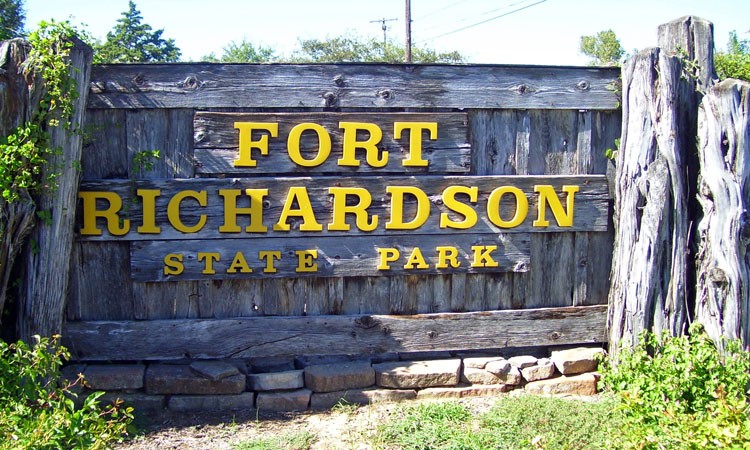
Fort Richardson was founded in 1866, following the end of the Civil War, first staffed near Jacksboro, Texas by elements of the 6th Cavalry. It was temporarily relocated around 20 miles north to a location known as Buffalo Springs in Clay County one year later. Buffalo Springs had the advantages of more plentiful water and timber, but was closer to the hostile tribes while also being further from supply depots in the Austin area. Construction was begun at Buffalo Springs, but was abandoned in favor of the original Jack County location after an Indian attack and several months of drought. The Jack County location was reestablished and consisted of about 300 acres along the Lost Creek tributary of the West Fork of the Trinity River. Construction had to start over as the previously abandoned buildings in Jacksboro had been used for building materials by the local settlers. Fort Richardson became the northern-most outpost in the chain of western forts.
 Texas History Notebook