As unlikely as it might seem, the Saturday, May 16, 1885 edition of the Stratfordshire (England) Sentinel Daily and Weekly carried an article with the title “A Pair of American Desperadoes” about the search for two criminals, Jim Courtright and Jim McIntyre, the latter of whom had just been apprehended.
Continue reading Jim McIntyre & Jim CourtrightTag: law enforcement
George Adolphus Scarborough
George Adolphus Scarborough was born October 2, 1859 in Natchitoches Parish, Louisiana to George Washington Scarborough and the former Martha Elizabeth Rutland. He was one of at least five siblings. In the 1860 census, the father is described as being a planter with 4,000 acres of land. In the 1870 census the father was shown as keeping a hotel. Between 1870 and 1880, the family had moved to Jones County, Texas. By then, George Adolphus had married the former Mary Frances McMahan on August 30, 1877 in McLennan County, Texas and began to raise their family.
Continue reading George Adolphus ScarboroughFrank James in Texas
Former bank robber Frank James lived in Dallas, Texas for a while. In an Associated Press newspaper article out of Dallas in The Indiana Gazette issue of April 26, 1957, it was reported that James’ former personal barber, an African American by the name of Johnny Dickson, had died at the age of 89. Dickson had said that James was a regular customer at his Dallas shop. A barber since the age of 14, when he started cutting hair, Dickson had to stand on a box or a stool to see the top of his customers’ heads. Dickson had come to Dallas in 1887 and began working at the Bird Cage Barber Shop. The barber shop got its name for the two caged canaries that were kept inside and sang for customers. Dickson said that Frank James would ride up to the shop on a handsome sorrel horse and just drop the reins, trusting the mount to wait for him. Dickson added that James was usually quiet and did not have much to say.
Continue reading Frank James in TexasJohn Henry Selman
The El Paso Herald Post carried an article on November 1, 1973 telling of two pistols formerly belonging to outlaw John Wesley Hardin that would be on display in the lobby of the State National Bank for about two weeks. One of the guns was a nickel plated Smith & Wesson D. A. Frontier pistol that Hardin was carrying when he died. The second was a Colt “Thunderer” .41 caliber pistol. The latter was engraved with pearl grips. This gun was taken from Hardin a few days earlier by Deputy Sheriff W. J. Ten Eyck after Hardin allegedly pulled the weapon and brandished it to take money he had lost in a crap game at the Gem Saloon, also called the Acme Saloon in other accounts. The article continued to relate that Hardin had moved to El Paso in 1895 and set up a legal practice after studying the law while in prison and passing the Texas bar. Hardin had reportedly killed as many as forty men, but was himself killed by John Henry Selman, a local constable.
Continue reading John Henry SelmanBen Kilpatrick and the Fort Worth Five
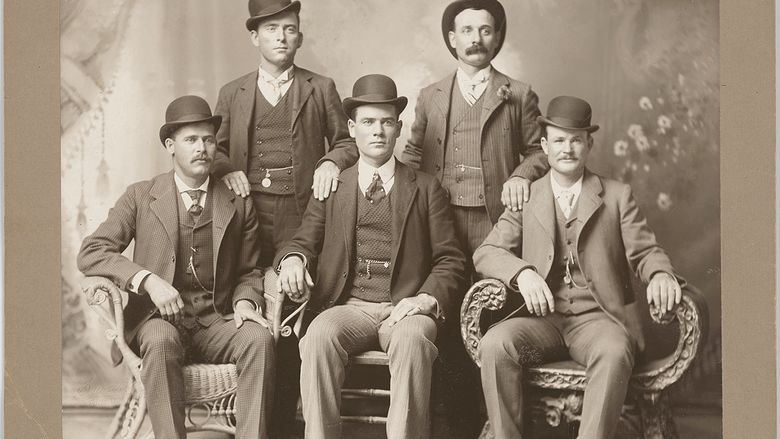
(Image credit: Smithsonian Institute)
This famous photograph, sometimes called the “Fort Worth Five,” was taken in 1900 an the Schwartz Studio in old downtown Fort Worth. Pictured are the following: left to right, front row: Harry A. Longabaugh (aka the Sundance Kid), Ben Kilpatrick (aka the Tall Texan), Robert Leroy Parker (aka Butch Cassidy); standing: Will Carver and Harvey Logan (aka Kid Curry). The photo is said to have helped authorities later to identify each of them and within twelve years, they would all be dead. Carver was killed in a shootout in Sonora, Texas the following year. Logan was killed in a shootout with a posse in Parachute, Colorado in 1904. He may have taken his own life rather than submit to being captured. Longabaugh and Parker are believed to have been killed in a shootout in Bolivia in 1908. Kilpatrick died in 1912.
Continue reading Ben Kilpatrick and the Fort Worth Five Texas History Notebook