The Albuquerque Journal issue of October 29,1938 carried this paragraph on page 10.
The death of Tex Austin removed to the big corral of “the Boss in the sky” one of the nation’s greatest showmen. Texas was an actor always, when staging a rodeo on the plains, in New York or London, or when merely walking down the street or welcoming guests in his cafe and bar in Santa Fe. He brought world-wide attention to New Mexico because he was the Barnum of the cowboy show business.
Albuquerque Journal – October 29, 1938
The man widely known as John Van “Tex” Austin had died a few days earlier at the age of about fifty. He had reportedly become despondent about a medical diagnosis of his impending blindness. Austin died in Santa Fe of carbon monoxide poisoning while sitting in his vehicle. His obituary called him a cowboy, ranch owner, world champion rodeo promoter and night club operator. After a service at Santa Fe’s St. John’s Methodist Episcopal Church, his body was cremated.
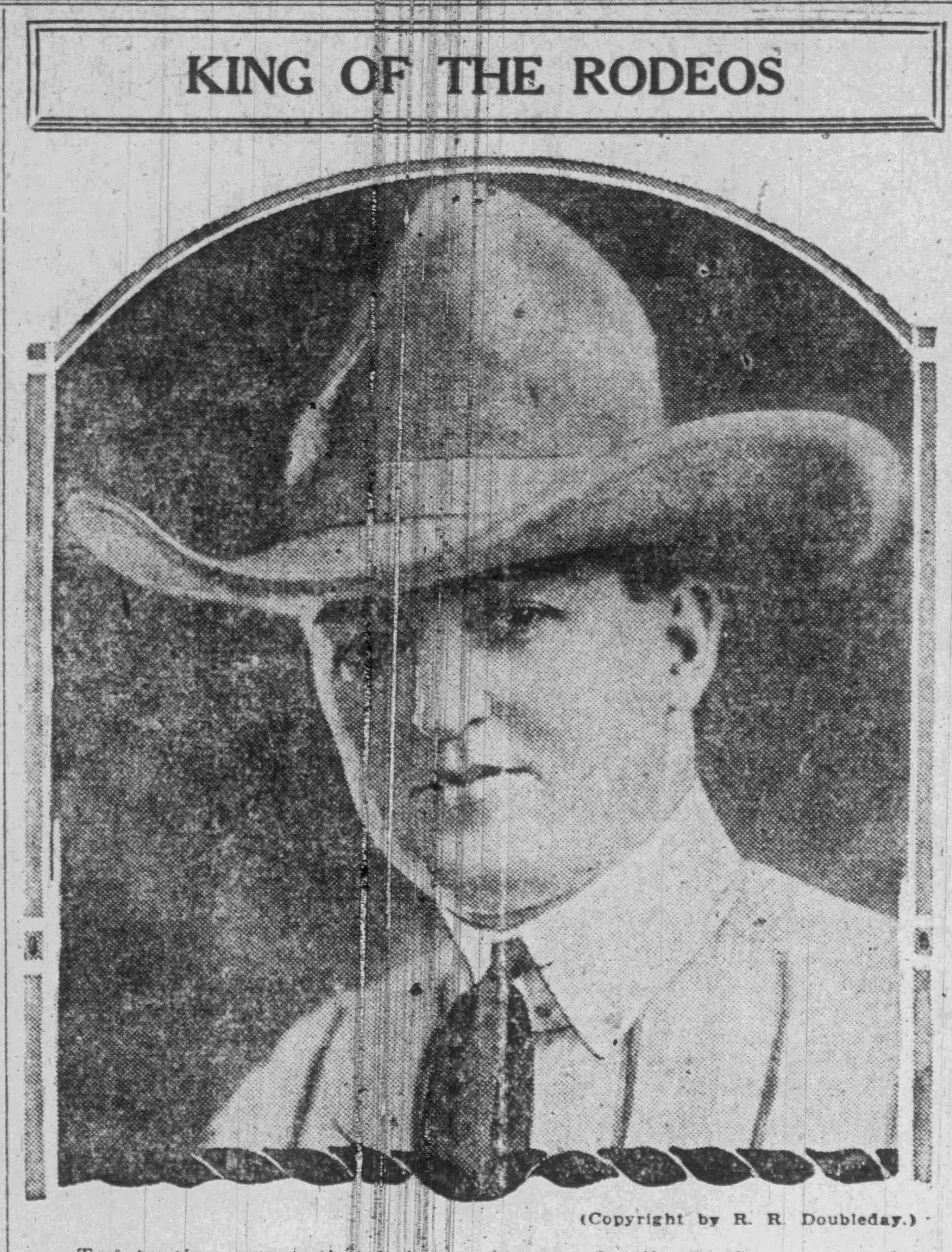
Image credit: The Minco Mistrel (Minco, Oklahoma) July 16, 1925
Austin was born Clarence Van Norstrand in St. Louis, Missouri to John S. Van Norstrand (1861 – 1936) and Clara Crabbe Norstrand (1870 – 1929). The couple had two children, Clarence and June. The 1900 federal census shows them as living in St. Ferdinand, St. Louis County, Missouri. John was a bookkeeper in his late 30s and their two children were Clarence (10) and June (7). In the 1910 federal census, the family consisted of the parents and June and they were living in Victoria, Texas.
Clarence/Tex was attracted to the western life and lifestyle. His true background was somewhat cloudy, as he had created a personna not unlike those that film studios might create for some actors of the day. His legend had him being born in Texas to a family named Austin. Some even mention that he fought in the Mexican Revolution under Villa. It is more likely that he simply learned to love the western lifestyle by living in the southwest. He is said to have left home and worked on ranches in the west for some years. He became attracted by what were called cowboy contests and had a vision that these events could become appealing events for the general public.
Some of his first attempts at organizing rodeo-type events date back to around 1916 when he organized a small event for a cowboy reunion in Las Vegas, New Mexico. He was only associated with it at the beginning, but this event went on for at least about fifty years before finally winding down. It was usually held around July 4th became a popular attraction during fiesta days. Austin’s rodeo there was a success. The following year, he staged a five day rodeo in El Paso, Texas which included many of the current rodeo events. Unfortunately, Austin had the misfortune of bad timing as in 1917 the area was suffering from an epidemic of Spanish Flu. Despite this setback, in 1918 he put on a rodeo in Wichita, Kansas that fared much better. The Kansas event is thought to be the first, or at least one of the first, rodeos under a roof. A few years later, Austin staged a big rodeo in New York City’s Madison Square Garden.
Austin was said to be private about his actual background, but his legend grew as his rodeo and wild west show events extended beyond the United States to locations as far as England and Europe. The most successful years for this operation appear to have been the latter half of the 1920s. He became known with nicknames like the King of the Rodeos or Daddy of the Rodeo. He was able to attract well known contestants and auxiliary acts to appear in his events including Hoot Gibson, Monte Blue, Ken Maynard, Dee Bibb and Gene Autry, among others. For at least five seasons in the latter 1920s, Austin organized the rodeo in Chicago held at Soldier Field.
In the 1920s he purchased a large ranch east of Santa Fe, New Mexico (near Pecos) and called it the Forked Lightning Ranch. Eventually he retired from the rodeo promotion business and settled on the ranch. The site included the ruins of an old pueblo and an adobe structure called Kozlowski’s Trading Post. He had a spacious adobe residence constructed and used the old trading post as the ranch headquarters. For a few years, he operated a dude ranch, offering rooms, horseback riding and other aspects of the cowboy lifestyle. Around 1933, he ceased doing the dude ranch business. How he disposed of the property is unknown. At least one account says he lost the ranch during the Depression. He and his wife Mary then opened a restaurant in Santa Fe. Located on Lincoln Avenue behind the old Governor’s Palace, about two blocks from the old Plaza. It was called Cafe de Los Rancheros. The day after his death, the Albuquerque Journal included this paragraph:
Cafe de Los Rancheros, better known to tourists, celebrities, rodeo hands and Santa Feans as”‘Tex’ Austin’s,” was closed Wednesday night – its gaiety and music replaced by poignant, pictured memories of the dust-clouded arena, cheering crowds, twising brocos and panting, bulldogged steers.
Albuquerque Journal – October 27, 1938
Some years after Austin’s death, his Forked Lightning Ranch was acquired by Texas oilman C. E. (Buddy) Fogelson and his wife actress Greer Garson who greatly expanded it and used it as their vacation property the rest of their lives. The greater ranch property has changed hands again since their deaths but at least some of the old Forked Lightning Ranch, including the trading post and the pueblo ruins, now belongs to the National Park Service as the Pecos National Historical Park.
After his death, newspaper articles began to appear about Austin. One Associated Press article on October 31, 1938 reported that his sister, June Van Norstrand Leonard said that Austin had changed his name “for show business purposes.” A man named Joseph A. Darst of St. Louis, said to be a childhood friend, had said that Austin was a boyhood chum of his named Van Norstrand. In a October, 1938 article in the Albuquerque Journal, more acquaintances were quoted. In this article, a person who said he had known Austin for twenty-eight years, still only knew him as Tex Austin. Following Austin’s funeral service, Austin’s body was cremated, as noted above. He and is wife Mary are said to have had a son named Lee. Nothing is known about the later lives of Lee or his mother. In 1976, the man known as Tex Austin was inducted into the National Rodeo Hall of Fame, part of the National Cowboy and Western Heritage Museum in Oklahoma City. His short biographical article on the museum website only refers to him as Tex Austin.
© 2023, all rights reserved.
 Texas History Notebook
That’s a rough way to go!!
LikeLiked by 1 person
There’s no indication of what the disease was that he might have been suffering from.
LikeLiked by 1 person
He would have had so many internal injuries over the years that it would have been difficult to determine, I suppose.
LikeLiked by 1 person