Ranald Slidell Mackenzie was born on July 27, 1840 in Westchester, New York to Alexander Slidell Mackenzie (1803 – 1848) and Catherine Alexander Robinson Mackenzie (1814 – 1883). He was the oldest of their five children. His father was the son of John Slidell and Mary Mackenzie but his father had adopted the name of Mackenzie (his mother’s maiden name) in 1837. The explanation for the name change was that it was a condition set out in order for him to claim an inheritance from an uncle, his mother’s late brother. Alexander Mackenzie had served for many years in the United States Navy after entering as a midshipman in 1815. He was promoted to lieutenant in 1825 and commander in 1841.
Alexander and Catherine were married in 1835 and all of their children carried the last names of Slidell Mackenzie, sometimes showing Slidell and Mackenzie hyphenated. All but one of their five children lived to be adults. Their surviving children included one daughter and three sons. The daughter, Harriet Duer Slidell Mackenzie, never married. Unfortunately, her obituary does not tell much about her personal life. The three sons each had long careers in the United States military. Ranald served in the Army, Alexander was a career naval officer and died in the line of duty in 1867 while in Taiwan, Morris Robinson retired from the Navy at the rank of admiral.
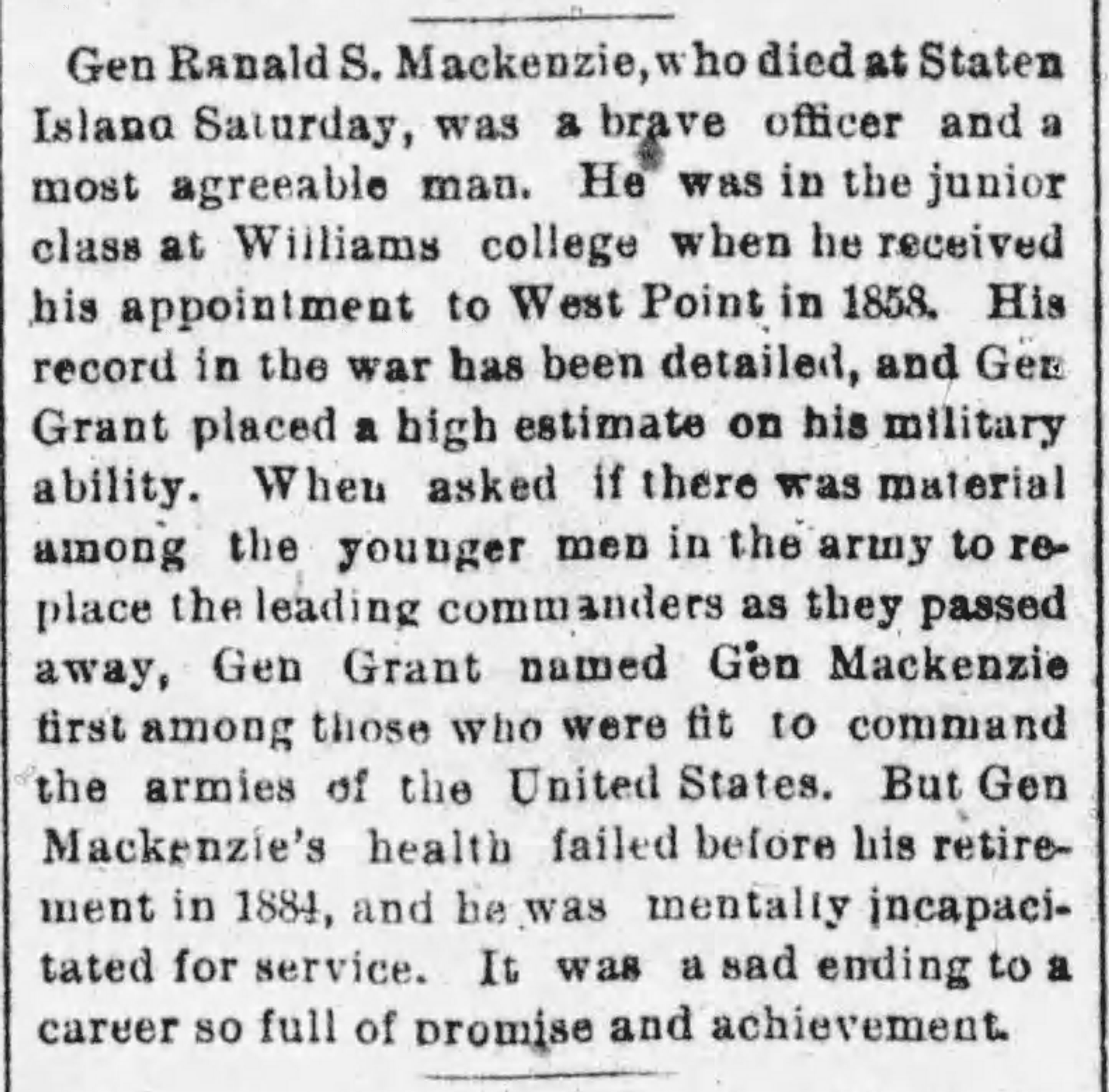
Ranald attended Williams College until he received his appointment to the United States Military Academy. He graduated from West Point in 1862, ranked first in his class. About thirty of his classmates served in the Army during the Civil War with Mackenzie reaching the highest rank, having received a brevet promotion to major general. At that time, he was the youngest major general of the volunteers. Mackenzie was wounded a number of times including being shot in the hand resulting in the loss of two fingers and also being struck in the chest by a spent artillery shell in one of his first battles. The loss of his two fingers was the source of his nickname of “Bad Hand” which is sometimes seen in articles.
During the Civil War, he was honored for gallantry for his service during the Battle of Manassas. He was again so honored for his service in the battles of Chancellorsville, Gettysburg, Petersburg, Opequan, Fisher’s Hill and Middletown. Mackenzie was present at Appomattox on April 9, 1865 after having been in pursuit of Robert E. Lee’s army. He was mustered out of the United States Volunteers in 1866. Mackenzie enlisted in the regular Army in 1867 and served until March of 1884 when he was retired for reason of disability in the line of duty.
Mackenzie was sent to serve in the American West soon after he reenlisted in 1867. By then, he was twenty-seven years old and had already experienced a great deal of action. He was stationed at Fort Concho in 1871 in charge of the 24th Infantry Regiment (Buffalo Soldiers) and assumed command of the 4th United States Cavalry. While there he was given the task of driving Arapaho, Kiowa, Cheyenne and Comanche tribes to reside on their reservations. He was considered to be effective in carrying out his assignments and gained the reputation of being able to track and capture key individuals who led the tribes. Over the next several years, he led more actions against the tribes. Mackenzie was said to be successful, culminating in the so called Red River War in the Panhandle which essentially put an end to the majority of hostilities.
In 1875 Mackenzie was assigned to command the forces at Fort Sill which included the Comanche-Kiowa and Cheyenne-Arapaho reservations. In this capacity, he directed actions to pursue and capture the remaining holdouts. General Phillip Sheridan is sometimes mentioned as a mentor of Colonel Mackenzie dating back to their Civil War assignments. Mackenzie was tasked by General Sheridan to carry out retaliatory raids against certain of the tribes identified as having carried out the massacre of the 7th Cavalry at Little Bighorn in 1876. Later that year, Mackenzie and troops under his direction surrounded and captured Red Cloud, chief of the Sioux tribe and other tribal leaders. After this, Colonel Mackenzie was given command of the Army Department of Texas and served in this capacity until his retirement.
Mackenzie never married but was once engaged to Mrs. Florida Sharpe. Florida Tunstall Sharpe was the widow of Dr. Redford Sharpe. Dr. Sharpe, originally from New Jersey, had served in the Union Army as the surgeon of the 3rd New Jersey Militia, the 6th New Jersey Volunteer Infantry and the 15th New Jersey Volunteer Infantry. He mustered out in 1865. The couple married in 1869 in Bexar County. However, their relationship was not destined to be a long one, as Dr. Sharpe died of undisclosed causes four years later in 1873. Mrs. Sharpe had likely become acquainted with Mackenzie before she met and married Dr. Sharpe. The two renewed their acquaintance many years after Dr. Sharp’s death and were engaged to be married in late 1883. While in San Antonio, Mackenzie is believed to have begun to manifest the effects of what has been described as mental and emotional deterioration. Weeks before the proposed wedding, he was involved in an altercation in which he was badly beaten. As a result, the marriage to Mrs. Sharpe never took place.
Dr. and Mrs. Sharpe had one son, Redford Tunstall Sharpe, who became a United States District Attorney. The son died in 1904 of pneumonia at the age of 32 while in Laredo, Texas. Mrs. Sharpe remained in San Antonio and was active in the community. She is also noted for having started the first free medical clinic. Mrs. Sharpe died in 1946 and was buried with her husband and her son in the San Antonio National Cemetery.
Various causes are suggested for Colonel Mackenzie’s mental decline. One of them that is mentioned is from an accident in which Mackenzie suffered a head injury after a fall from a wagon while he was serving at Fort Sill. Another is a possible contributing illness. As noted above, Mackenzie had also previously suffered numerous wounds in the line of duty including having been shot with bullets and an arrow.
Mackenzie was retired from the Army with a full pension in 1884. Accompanied by his sister, he returned to the east where at least for some time he was committed to one or more mental institutions. Mackenzie never recovered from his disability and died on January 19, 1889 in New Brighton, New York. He is buried in the cemetery on the grounds of the Military Academy at West Point, New York.
© 2024, all rights reserved.
 Texas History Notebook