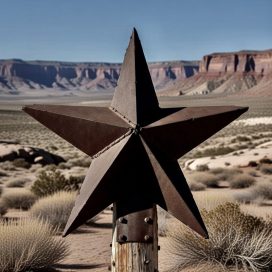
This volume was Larry McMurtry’s prequel to his epic cattle drive novel “Lonesome Dove.” “Dead Man’s Walk” was the third book in order of publication. A second prequel is “Comanche Moon” and the sequel is “Streets of Laredo.” A 1995 headline had stated that after Lonesome Dove, McMurtry planned “no ride into the sunset.”
“Dead Man’s Walk” is intended to portray the earliest days of his fictional characters Gus McCrae and Woodrow Call. The author said that it was set 35 years before the cattle drive. The story line is centered around the actual event known as the Santa Fe Expedition in which several hundred individuals from Texas accompanied by a military contingent set out with wagons, mules and horses from Austin in 1841. Their ambitious objective was to take the New Mexico capital of Santa Fe (then part of Mexico) and push the boundaries of the Republic of Texas to the west. On the surface, the goal was to try and persuade Mexican officials of the economic benefits of leaving the control of Mexico and coming under the Republic of Texas. Part of their cargo included flyers promoting such a move. If peaceful efforts failed, the expedition could use military force. In hindsight, of course, the entire venture was doomed from the beginning.
Newly signed Rangers Gus and Call are portrayed as young men, perhaps around 20 years old or younger at the time. Throughout the book, facts from their own backgrounds are revealed in addition to relating how the two became acquainted. The friends decide to volunteer for the expedition, lured both by the prospect of the adventure, wages and the rumor of vast treasures supposedly there for the taking. On the journey the participants would have to cross many miles of arid West Texas plains to reach Santa Fe. As in the historical account, they encounter stealthy and hostile Comanches and Apaches, face weather calamities, supply shortages and other problems. Numerous participants abandon the journey and turn back after they encounter hardship. The leadership and scouting expertise of the civilian and military personnel commanding the expedition are questionable and contribute greatly to the end result. Some of their horses and mules are stolen, supplies are lost or consumed and certain members who elected to remain are killed. Their paid scouts are among the ones who turn back. Yet in spite of all this, the constantly dwindling force decides to continue.
After days or weeks of traveling, they cross the Texas bounder, as in the historical account. The Texans are soon outnumbered by a larger and overwhelmingly better equipped contingent of Mexican militia. The rest of the story deals with the aftermath of their capture. The book’s title refers to the long march that the prisoners are subjected to after their capture, the Jornada Del Muerte or Dead Man’s Walk. The fictional account generally follows events in the same manner as the actual events, though it blends in certain elements of the later (better organized but also unsuccessful) Mier Expedition.
Selected characters from the book:
Fictional:
- Augustus “Gus” McCrae – young Ranger.
- Woodrow Call – young Ranger.
- Caleb Cobb – Civilian leader of the expedition, apparently not based on any one individual.
- Matilda “Matty” Roberts – In the book, she appears first as a camp following prostitute before settling down with a relationship with one person (Shadrach). Her character is likely fictionalized, resembling a typical camp follower.
- Clara Forsythe – Gus’ love interest. He first meets her as the daughter of an Austin mercantile store owner. Clara also appears in the latter part of “Lonesome Dove” as a main character.
- Shadrach – Old Ranger/scout in the expedition.
- Long Bill Coleman – Participant in the expedition.
- Kicking Wolf – Comanche warrior and skilled horse thief, likely based on a composite of several actual individuals.
- Lady Lucinda Carey – Captive of Mexican authorities along with her son Willy.
- Major Randall Chevallie – Possibly fictionalized character possibly based on Major Michael Hancock Chevallie.
- General Phil Lloyd -Military leader, apparently not based on any one person.
- Major LaRoche – Mexican officer born in France, apparently not based on a historical figure.
Historical:
- William Alexander Anderson “Bigfoot” Wallace – Scout and adventurer prominently mentioned in Texas history. However, Wallace is not known to have actually participated in the Santa Fe expedition, although he was actively involved other events.
- Buffalo Hump (Po-Cha-na-quar-hip) – Strong Penateka Comanche adversary in the book, portrayed as a prime nemesis of the expedition. In reality he was an important Comanche chief for many years. Buffalo Hump was an influential leader in the Comanche tribe from around 1830 until his surrender somewhat early in the Indian Wars. He was an active leader during the Great Raid of 1840 after the Council House Fight. The author refers to him in several of the four book series.
- Mexican Captain Salazar – Captain Damasio Salazar led the Mexican militia against the Texas participants in the expedition.
- Juan Gomez – Apache war chief, just referred to as Gomez in the book.
- John Joel Glanton – Texas Ranger and later mercenary. His biographical sketches refer to alleged brutality against combatants as well as peaceful tribe members. Not a major character in the book.
- James Kirker – Mountain man, trapper and buffalo hunter with similar allegations of brutality and violence as Glanton. Not a major character.
- Charles Goodnight – Makes an appearance in the book, not a major character.
- “Bose” – No last name is given in the book but is a likely reference to Bose Ikard (associate of Goodnight). He is mentioned in the book but has no dialogue. Not a major character.
The book was released in 1995 and follows the general flow of the historical event. There are geographic variances, participant’s roles and other differences between the book and what is commonly known about the actual events. The book was roughly half the length of “Lonesome Dove” and was considered a success.
Almost immediately, there began to be discussions about a movie or television adaptation. A mini series was chosen. The author and Diana Ossana collaborated on the script or teleplay and the following individuals were cast:
- David Arquette – Gus
- Johnny Lee Miller – Call
- F. Murray Abraham – Caleb Cobb
- Patricia Childress -Matilda
- Jennifer Garner – Clara Forsythe
- Harry Dean Stanton – Shadrach
- Ray McKinnon – Long Bill Coleman
- Jonathan Joss – Kicking Wolf
- Haviland Morris – Lady Lucinda Carey
- Brian Dennehy – Major Chevallie/Chevalier
- Bert Roberts – General Phil Lloyd
- Joaquim de Almeida – Major LaRoche
- Keith Carradine – Bigfoot Wallace
- Eric Schweig – Buffalo Hump
- Edward James Olmos – Captain Salazar
- Victor Aaron – Juan Gomez
- Boots Southerland – John Joel Glanton
- Brad Greenquist – James Kirker
- Chris Penn – Charles Goodnight
Most of the major characters from the book appear in the teleplay. The miniseries was filmed during the last 90 days of 1995 and released the next year. Filming took place in Lajitas, Terlingua, Van Horn, Fort Davis and the Big Bend Ranch State Park in Texas. It was well received. The production was nominated for a Primetime Emmy for David Bell’s musical composition; it won an award for Best TV Teleplay in the 1996 Lone Star Film & Television Awards; Edward James Olmos won a NCLR Bravo Award for Outstanding Individual Performance in Made for Television Movie or Mini Series. It is still available for viewing on some streaming services.
© 2026, all rights reserved.

