John Wayne enjoyed a long film career. Many of his movies were westerns in which Wayne was regularly horseback. Early in his career he made numerous movies that are now referred to as “B-westerns.” This was a time before television, when motion picture theater attendance was a major factor in family entertainment. So called “B-movies” were lower budget films made to satisfy the demand for product in various genres, including westerns. They were shown by themselves or in addition to major films in double features. According to public information, Wayne’s first horses included a number of unnamed mounts rented by the studios from contracting stables. Two of the Wayne film horses that the website b-westerns.com mentions are “Duke” and “Starlight.” Duke was a white horse, a popular color at the time, and appeared in at least six films. Starlight was also a white horse and appeared in at least two films.
During the next phase of Wayne’s career according to a variety of sources, his mounts included “Banner” – a big bay/sorrel, “Steel” – a large sorrel stallion, “Alamo” – Wayne’s own horse and “Beau” – another sorrel. Other Wayne film horses mentioned include “Cocaine” – said to have been ridden by his stunt double in 30 films and “Zip Cochise” – an Apaloosa which Wayne rode in the film “El Dorado.”
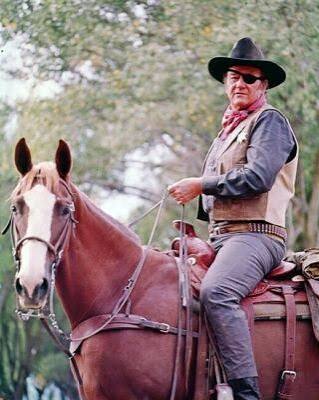
In many of Wayne’s last movies, his favorite horse was said to be a 1,600 pound chestnut/sorrel named “Dollor.” This horse is usually cited as having appeared in “Big Jake,” “True Grit,” “Chisum,” “The Cowboys,” The Train Robbers,” “Rooster Cogburn” and his last western, “The Shootist.”
There is some confusion regarding the name. In articles it may appear as “Dollar” or “Dollor.” At least one newspaper article contends that there were actually two different horses in Wayne films over the years and that they had similar names, Dollar and Dollor. He says that the horse called “Dollor” only appeared in the last three or four John Wayne films. In various recorded images, the two had unique leg markings and significantly different blaze markings, the blaze being the white stripe running down the horse’s face. He says that Dollor had the wider blaze of the two. However, most articles do not refer to image differences and say that there was one horse named Dollor which appeared in Wayne’s last seven pictures. However, it does not take a sharp eye to note that Wayne appears to be riding two different horses at various times during the opening credits and first minutes of “The Shootist.” Two different mounts were also apparently used in the “four rail fence” scene in “True Grit.” A likely explanation is that stunt doubles and background horses are commonly used for scenes in films.
Sorrel refers to the color of the horse’s coat which may vary from some shade of red to a coppery color. The mane and tail may be the same color or lighter. A chestnut horse is characterized by a red based coat with no black in the body, mane, tail and lower legs.
John Wayne owned his own horses, but “Dollor” was apparently not owned by the actor. As in almost all of his career, the horses he rode were contracted by the studio and furnished by an outside stable. In this case, the stable was Dick Webb Movie Productions, owned by Richard “Dick” Webb. There have been several people bearing the name Dick Webb in the film business over the years: actors, special effects technicians, producers and directors. The stock contractor here was Richard Taft “Dick” Webb born April 8, 1909 and died February 1, 2007.
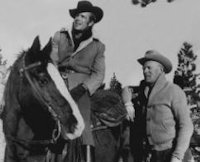
Dick Webb had a long career in motion pictures and television. In addition to livestock or stock contracting, he did stunt work and other jobs. In one production named “The Blue and the Gray,” the 1982 Columbia Pictures miniseries was filmed in Arkansas. In addition to mentioning that several of the film crew fell in love with the state and bought property there, at least two crew members developed romantic ties with local women and became engaged to marry them. Dick Webb factors into the story in that his company used some local horses. As head wrangler, he liked them so much, he bought a number of them for his company. Webb was called chief wrangler on the 1962 production “How the West was Won.” Webb is shown at the right with actor George Peppard from that film.
The quarter horse gelding “Dollor” stood 15 hands high. He had no recorded bloodline. Dollor was a quarter horse but was not registered with the AQHA, American Quarter Horse Association. The horse was believed to have been foaled around 1968 and, as noted, was owned by Webb’s company. Wayne took a liking to the horse and was so fond of it that he made legal agreements that no other actor could ride him in films and that Dollor would not be sold by the stable during his lifetime.
Horses used in westerns have to be trained not to adversely react to screen gunfire, cameras and large crews working around them. Wayne loved the way Dollor was smooth in his gait and calm in his demeanor during the chaos of filming. As an aside, Wayne was able to persuade the screen writers on “The Shootist” to let his character instruct Ron Howard’s character to give Old Dollor a double helping of oats.
Webb’s company honored the Wayne agreement. Not until after Wayne died in 1979 did they use Dollor in at least two television series, Hart to Hart and Dynasty ridden by two of the main characters. As Webb’s career and the western genre drew to a close, Dollor was said to have been briefly owned by a rodeo association before being finally conveyed to new owners in 1983. The acquisition was funded by Midlothian, Texas residents Howard and Debra Keffeler, plus two of their friends, David Pellham and Phil Yarnell. In 1987, after the purchase, the Keffelers showed the horse in the Southwestern Exposition and Fat Stock Show Parade. A contemporary news article in the Fort Worth Star-Telegram gave some of the history of the horse, stating that he was about 20 years old at that time. The article added that potential foreign buyers prior to the Keffelers had offered “$60,000 to $70,000” which prompted them to acquire the horse. They did not want him to go outside the United States, they said, and were able to put together the purchase. Once in their hands, he lived a pampered life. Dollor was housed in a nice barn equipped with ceiling fans and heated, depending on the outside weather.
Dollor made several more appearances over the years before his apparent death around 1995. It happened without fanfare. Newspaper articles mention that a Wayne museum in Iowa offered to display Dollor after taxidermy but as far as we know the offer was declined.
© 2026, all rights reserved.

