Charles Goodnight wrote of the death of his friend Oliver Loving in the book The Trail Drivers of Texas by J. Marvin Hunter. The book is widely available for purchase, and also can be downloaded. In it, Hunter has assembled sketches and observations of the cattle drivers of the 1800s.
Continue reading Death of Oliver LovingWilliam Cowper Brann
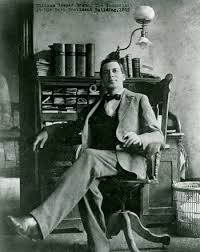
(Image credit: Texas Co-op Power Magazine)
William Cowper Brann was born in Coles County, Illinois in 1855 and was raised by a local farmer after his mother died when he was 2 1/2. His first job was to serve as a bell boy at a local hotel. Following that, he worked as a painter, a drummer, a grainer, a printer, a reporter and an editorial writer. It was written that he talked his way into a position as chief editorial writer for the Houston Post. Brann earned a reputation for being a hard worker at whatever he attempted to do.
Samuel Maverick

Samuel Augustus Maverick was born in the summer of 1803 in South Carolina to Samuel and Elizabeth Anderson Maverick. His father operated an import business. Young Samuel worked in the family business, graduating from Yale University in 1825. He left the family business and moved to Virginia in 1828 to study law. For a while he practiced law and in 1833 he moved to Georgia for a year before relocating to Alabama to operate a plantation that had been given to him by his father.
Bonnie and Clyde Come to Wellington, Texas
Wellington, Texas is in Collingsworth County, located where the Texas border departs from the Red River and heads due north, on the eastern edge of the Panhandle. At its peak, Wellington’s population was around 3,700 people and since the 1990s, it has hovered around 2,000 to 2,500 people.
When Texas Invaded New Mexico
In 1841, Republic of Texas President Mirabeau B. Lamar had a vision to expand the borders of the young republic further west, perhaps as far as California. Lamar had won the 1838 presidential election, following Sam Houston, the previous elected president. Lamar was in various ways the ideological opposite of Houston. He became the second of four elected presidents in the short life of the Republic and served from 12/10/1838 to 12/3/1841. At the time, the Texas economy was suffering and Lamar acted on the supposition that he had authority to pursue trade that was currently operating along the Santa Fe Trail.

