There are two Texas traditions involving state governors and the Bible. They are referred to as the “Supreme Court Bible” and the “Governor’s Bible.” The following is the story of the Supreme Court Bible.
Tag: history
Governor James V. Allred and the Texas Rangers
The 1935 election of James V. Allred as governor of Texas marked a turning point for the Texas Rangers as a law enforcement organization. For several decades, the force had not kept up with the growth of crime in the Lone Star State. There were a few bright spots, however, such as former Texas Ranger Frank Hamer’s 1934 stakeout and ambush of outlaws Bonnie and Clyde. Although it had the effect of boosting the image of the Rangers that had deteriorated under earlier governors, the crime problems in the state still existed.
Continue reading Governor James V. Allred and the Texas Rangers
Bonnie and Clyde Film (1967) versus the historical facts

(Image credit: IMDB.com)
This summer will mark the 50th anniversary of the release of the feature film Bonnie and Clyde. It was directed by Arthur Penn (1922-2010), who also directed around two dozen other films including The Missouri Breaks, Night Moves, Little Big Man, Alice’s Restaurant and The Miracle Worker. Penn had received his start in the early days of television, having been involved with productions in series including The Gulf Playhouse, Goodyear Playhouse, Playhouse 90 and others.
Continue reading Bonnie and Clyde Film (1967) versus the historical facts
Juan Cortina, patriot or bandit?
The Cortina Wars is a name given to armed conflicts precipitated by a Mexican rancher named Juan Cortina. Juan Nepomuceno Cortina was born in 1824 in Tamaulipas, Mexico into a cattle ranching family. His mother, Trinidad Cortina inherited some property in the late 1820s that was in the general area of what we know as Brownsville and Matamoros, located on both sides of the Rio Grande. At this time, the Rio Grande geographically divided the two areas, but it was all part of Mexico until after the Mexican-American War, which essentially moved the Mexican border from the Nueces River to the Rio Grande.
Continue reading Juan Cortina, patriot or bandit?Col. Richard E. Cole, Doolittle Raider
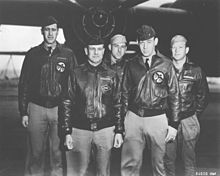
(Image credit: U. S. Air Force. Cole is on the front row, to Doolittle’s right.)
Just a little more than one month after the Doolittle Raid on Tokyo on April 18, 1942, details were released to the media about the military action. The occasion was an award ceremony honoring pilots and crew of the historic attack. In an Associated Press report out of Washington on May 22, the identity of the leader was revealed to be Brig. Gen. James H. Doolittle. Coming only a few months after the surprise Japanese attack on Pearl Harbor that brought the United States into World War II, the raid shook the Japanese belief that the U.S. could not reach them on their own soil. In addition, it greatly improved the morale in the United States at a time when it was extremely low.

