Before the Texas Revolution, the official religion of the area was Roman Catholicism according to Spanish law. Landowners were required to espouse the Roman Catholic faith and many did so in order to obtain title to their land. However Protestant families moved to the area prior to and following the Texas Revolution. R. E. B. Baylor, a Baptist, came to Texas in late 1839. By then, there were already a number of Baptist families in Texas. After a couple of failed efforts, the Baptist Union Association was formed in the fall of 1840 and included churches from La Grange, Travis and Independence. Baylor was a circuit judge and was an ordained minister. By about 1845, there were hundreds of fellow Baptists in the area. Among other things, the Association had been concerned about education and formed an Education Society of which R. E. B. Baylor was selected to be President.
Tag: history
The Governor’s Bible
There are two Texas traditions involving state governors and the Bible. They are referred to as the “Supreme Court Bible” and the “Governor’s Bible.” The following is the story of the Governor’s Bible. We will talk about the Supreme Court Bible in a later article.
Battle of the Neches
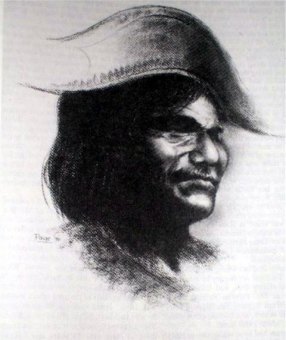
(Image credit: TexasCherokeeNation.org)
On July 16, 1839, the last major battle between Texas forces and the Cherokee tribe along with other tribal bands took place. The Cherokee had first come to Texas shortly after the turn of the century, long before the Texas Revolution, and had settled near the Red River. Much of the time thereafter, their leader was Chief John Bowles, pictured in the image above, also known as Diwal’li. There are other variations of his name, but we will refer to him as Chief Bowles. The Chief was thought to have been born around 1756 to a Cherokee mother and a Scotch-Irish father. He is said to have had the features of both parents including reddish hair, Cherokee features and freckled skin.
Neil Love McLennan (1787-1867)

(Image credit: sutphen.org)
One of the early settlers near Waco, Neil Love McLennan was born in Isle of Skye, off the western coast of Scotland in 1787. He came to America in 1801, first settling in North Carolina, married the former Christian A. (Darthal) Campbell in 1814, and then relocated in 1816 to Florida. After living there a number of years, in 1834 he and his family along with two brothers and others sailed a three masted schooner from Pensacola, Florida to the mouth of the Brazos. They arrived there in early March and continued on upriver as far as they could.
Yturria Ranch
During its ownership and control of Texas, Spain had attempted to colonize the areas along the Rio Grande to take advantage of its fresh water system. The King of Spain granted ownership of blocks of land to certain private individuals who had shown an interest in colonization and had resided in the area for a number of years. After Mexico declared its independence from Spain, most of the Spanish grants were upheld. Similarly, most were also recognized under the Texas Republic, following its establishment.
Continue reading Yturria Ranch
