James Augusta Kerr was one of the more interesting people in the early days of Texas. He was born September 24, 1790 in Boyle County, Kentucky to Reverend James Kerr II (1749 – 1811) and Patience Wells Kerr (1759 – 1799). He was the seventh child and second son of the couple’s ten children born over a twenty year period from 1777 to 1797. The father, James, was a farmer and a Baptist minister, more accurately described as a circuit riding preacher. A descendant, James Kerr Crain, writes that Patience, the youngest of a large group of children, had eloped with her husband to be after her parents objected to the relationship, but the union lasted until her untimely death. The mother, Patience, died in 1799 after taking ill on a horseback trip to visit one of their older children. Her husband preached the funeral, which was said to be the first Protestant sermon preached in the sparsely populated Upper Louisiana Territory. Rev. Kerr married a widow by the name of Phoebe Bonham one year after the death of Patience. The family moved to St. Charles County, Missouri in 1808 and Rev. Kerr passed away there in 1811.
Continue reading James KerrTag: towns
Indianola
Hurricanes have always figured into Texas history. Twenty-five years before the well known hurricane that damaged so much of Galveston in 1900, another one struck the town of Indianola. Indianola was located roughly halfway between Galveston and Corpus Christi on the western side of Matagorda Bay. It is now a lightly inhabited community a few miles southeast of Port Lavaca, but once was a busy port.
Continue reading IndianolaTwo Texas Grigsby Families
There have been numerous families with the Grigsby name who lived in Texas around the time of the Texas Revolution and the Republic of Texas. We mention two families today. They both had interesting stories. One settled near the eastern border of Texas, generally in Jefferson County and the other more in and around Houston County.
Continue reading Two Texas Grigsby FamiliesCowboy Strike of 1883 and the Ghost Town of Tascosa
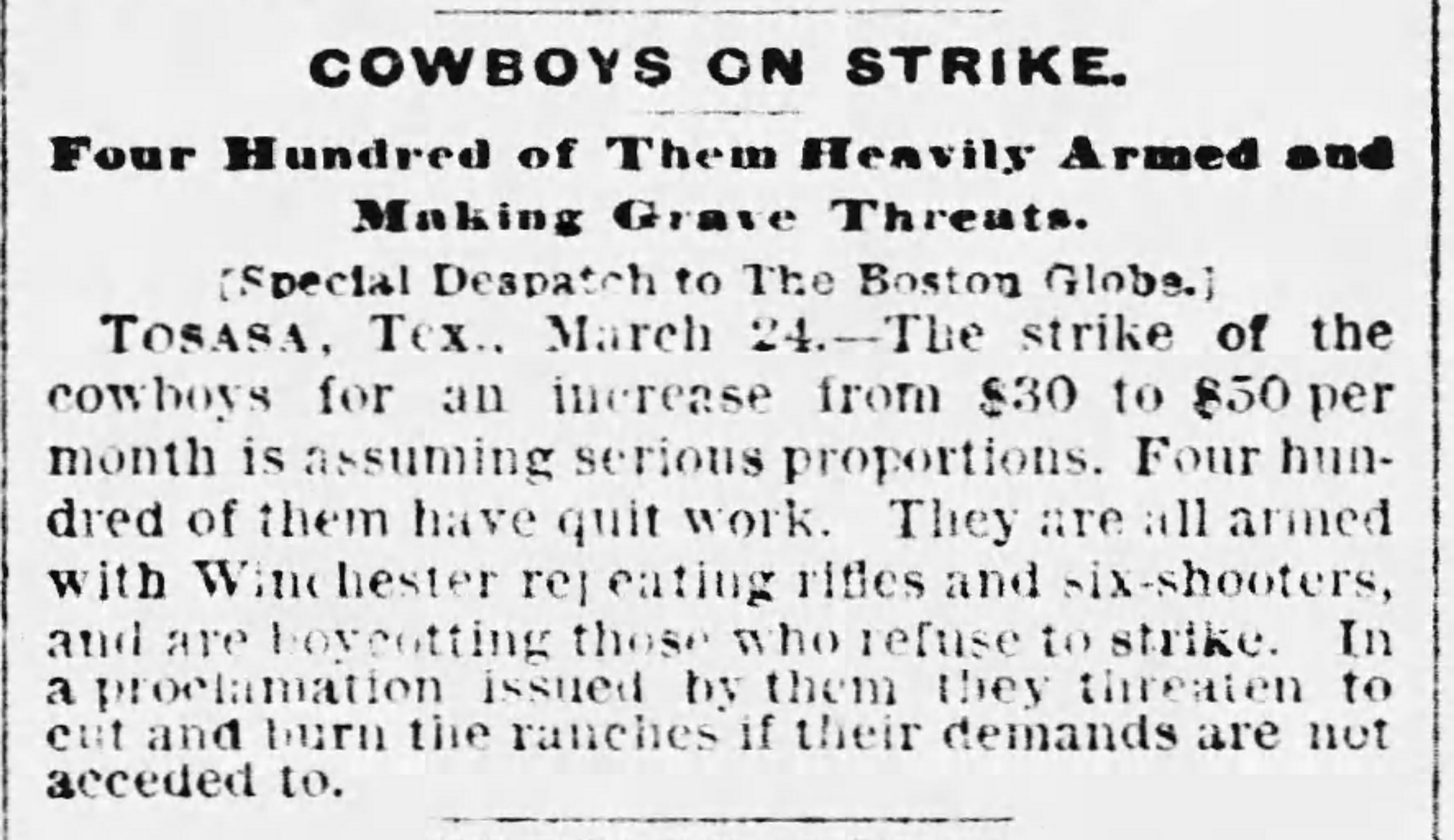
In the spring of 1883, the newspapers like the Boston Globe reported that hundreds of cowboys went on strike for higher wages. The next day, a Wyoming newspaper gave more details, repeating the $50 per month demand. This article alluded to the possible threats of danger facing cowboys who declined to participate in the strike, but gives the number of strikers to be two hundred. Both have typographical or transcription errors. “Tosasa” in the Boston Globe article is probably a misspelling of Tascosa. The Wyoming article calls the county of the strike “Lascasa” and places it near the Texas-New Mexico border. The articles begin to settle down in a few days and give the location to be Tascosa.
Continue reading Cowboy Strike of 1883 and the Ghost Town of TascosaGeorge W. Littlefield
George Washington Littlefield is the namesake of Littlefield, Texas. He was born on June 21, 1842 in Como, Mississippi to Fleming Littlefield and Mildred Terrell Satterwhite Littlefield, a widow with five children and whose husband John Henry White had died in 1839. Fleming and Mildred had married in 1841 and first lived in Mississippi but conflicts are said to have developed between Fleming and the family of Mildred. Around 1850, Fleming and Mildred moved to Gonzales County, Texas where they operated a plantation. Their union produced more children who lived to adulthood, G. W., Martha Mildred and William Phillip. However, their family as then configured was not to last, as Fleming died in 1853. Matilda continued to run the plantation with the help of her sons and others until her own death in 1880. Both Matilda and Fleming are buried in the Masonic Cemetery in Gonzales.
Continue reading George W. Littlefield
