Spring is often a vulnerable time for West Texas residents when supercell storms pass through the area. Newspapers noted that two people were killed the evening of May 6, 1949 when a tornado struck the north side of the small oilfield community of Sundown, roughly 45 miles west of Lubbock in Hockley County. The next morning, reports announced that two individuals were killed including a young Church of Christ pastor and his three year old daughter. Two more unnamed people were reported missing. Several others were injured and more were said to be trapped in the rubble but no more fatalities were reported. All the missing individuals were located. That same night, tornado activity, part of the same huge storm, was reported in Morton and the wheatland outside Dalhart but there were no fatalities. Near Dalhart, the tornado was said to be on the ground for about twelve miles, but it only destroyed crops. About two weeks later, a twister dropped down in the Soldier Mound community a few miles north of Spur, killing one person and injuring several others. The fatality and a number of those injured were in a residence that was destroyed. A small child, a grandchild of the deceased, was found 100 yards away from her, the but miraculously the child was uninjured. A Baptist church and five farm houses were also destroyed, but there were no other fatalities.
Another tornado hit Sundown in mid September, 1950, but there were no fatalities. Over the next twenty years, tornado activities were reported in nearby towns such as Tahoka, Littlefield, Acuff, Idalou, Stinnett, Wolforth and other communities. One person was reported killed and 48 reported injured June 2, 1965 near Hale Center, Cotton Center and Spade from a tornado, also causing a lot of property damage. Through all of this, the city of Lubbock had regular warnings but had no serious tornado events. That all ended May 11, 1970.
A massive storm hit the area the night of May 11, 1970. It was the first twister to strike the downtown area but was found to be the second of two to strike the area. A few minutes earlier one had touched down east of town. The next day newspapers rushed to provide updates. The May 12, 1970 issue of the Fort Worth Star-Telegram opened its column with these comments. “A tour of Lubbock proper revealed that only a miniscule number of structures were left undamaged. Asst. City Manager Bob Wilson said the storm cut an eight-mile-long path through Lubbock, doing the greatest damage and bringing the most deaths to the north and northeast portions.” Another article commented on the likelihood of tornadoes in Texas during the month of May and that the Lubbock tornado was 17 years to the day from the huge twister that struck Waco, Texas.
First person accounts noted that people in nightclothes were seen wandering the streets at sunup surveying the damage and that looked like a giant lawnmower had cropped all the trees for blocks. A person in the Overton Section noted that houses in their neighborhood were mostly small and of wood frame construction and that many had collapsed under the force of 100 mile per hour winds. Another person mentioned that their clocks had all stopped at 9:40 p.m. The noise of the wind was terrific and there were loud sounds of hail striking her roof. One person said a neighbor had tried to check on her during the worst of it. The noise of the storm was so loud that she could not hear them knocking on her door, nor could she open the door. A Texas Tech student from Lamesa said that he knew it was a tornado when his ears began to pop from the change in pressure. A clock there on campus at a gym had stopped at 9:27. Student residences were dispersed around town, but most of the university’s 18,000 students had begun to leave since the spring semester just ended. A person sitting in a downtown newspaper office remembered that the ceiling on his floor just began to lift up. When it lowered, water began to gush in. There were several car dealerships near downtown. One had just opened a week earlier and a sales manager reported heavy damage to their inventory.
A managing editor of the local newspaper observed that he was talking on the phone to Associated Press in New York City when the tornado began to close in on his building. The noise increased to the point that he could not hear anything else, and then all the power went off in his building. A car hauler was loaded with vehicles and had parked on the city square. The cars survived but all their hazard lights were flashing once the storm had passed. Lights were still on in one downtown building but most of the downtown illumination immediately following the storm came from emergency vehicles. One person tried to exit his office building using the stairs and noted that there were large cracks in the stairs as he descended. The Lubbock paper had to be printed in Amarillo after structural damage and lack of power hit their printing facility. A police officer said that water in the streets was at automobile headlight level immediately following the twister. There were some reports of looting until local and state law enforcement personnel could assist.
It was soon determined that there were actually two tornadoes that struck Lubbock. Below is Dr. T. Theodore Fujita’s map reconstructing the paths of both twisters.
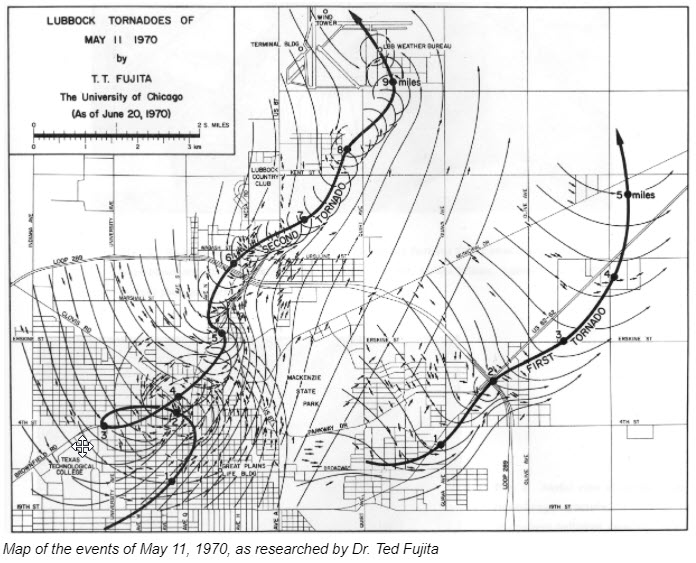
Initial reports were that around two dozen people had died. The final death toll was 26. Those injured were estimated at around 1,500 with as many as 100 to 250 considered seriously injured. The two major local hospitals, then named Methodist Hospital and West Texas Hospital, soon filled with individuals seeking treatment. The downtown tornado (called the “second tornado” in the map) touched down near the Texas Tech campus before it veered toward downtown. At that time Lubbock’s population was estimated to be 160,000 to 170,000. Some 25,000 of the city’s 100,000 telephones were out of order and circuits were jammed as welfare calls in and out of the system choked its capacity. Much of the city’s electric service was interrupted. The mayor was quoted as saying water service was also affected. The city used an estimated 40 million gallons of water per day but only had a reservoir of 4 million gallons, so bottled water was needed for basic drinking water supplies until service could be restored. People displaced from their homes were given shelter at a coliseum, local schools and other facilities.
The damage extended to 2,500 square blocks of the city. Wind gusts were estimated at over 100 miles per hour. The downtown tornado was on the ground for 8 to 8.5 miles and its width was estimated to be as much as 1.5 miles. Its force was estimated at F5 with some peaks to F6. The Fujita scale was later restated where F5 is the largest classification. The tornadoes were estimated to have been on the ground for only about 20 minutes. Damage was believed to be in the hundreds of millions of dollars at the time.
The City of Lubbock unveiled a memorial in 2021. Part of its design is intended to be a 3D display of downtown streets and the path of that tornado through them.
© 2026, all rights reserved.

