It’s been said that in rodeo, eight seconds can seem like an eternity. In the early days of rodeo, the role of rodeo clowns began. Initially they provided entertainment by dressing up with face paint and garish costumes. Between events, they would sometimes do stunts, tell jokes and the like. They also stayed in the arena most of the time and during bull riding events, they attempted to distract the bulls after the rider either completed the timed event or got bucked off. As American rodeo expanded and professional organizations developed, the need for specialized protection for the contestants increased.
The role of “bullfighter” evolved from that of the rodeo clown. Rodeo bullfighters are not to be confused with matadors in the Spanish/Mexican events known as bullfights. Bullfighters dress like rodeo clowns and wear athletic protective gear. They provide distractions for the animal in the seconds that it takes for the contestant to reach safety. Sometimes riders may get hung up in their rigging which makes it even harder for them to avoid the animals. Bullfighters intervene with the bulls along with clowns and barrelmen. Barrels and other props provide distractions and sometimes protection from the rodeo stock. Bullfighters are highly respected and appreciated by the contestants. Bullfighters are not expected to outrun the bulls, but with speed and agility they attempt to outmaneuver the animals. Their tactics may include touching the bulls as they try to help herd them to the arena exits. They usually wear brightly colored clothes, but it is movement that usually distracts the animals.
Today, bullfighters are contracted by the Professional Rodeo Cowboys Association (PRCA). They must be approved by the PRCA and are paid or contracted by rodeo committees or stock contractors. They must meet safety and performance expectations, follow all PRCA rules and procedures and prove themselves to be capable of protecting professional riders. They often train by bullfighting at smaller circuits until they become associated with PRCA.
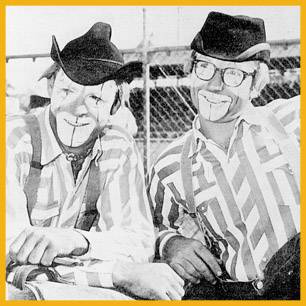
Two early bullfighters were George Doak and Junior Meek. George Doak was born May 18, 1937 in Fort Worth, Texas. The story is told of Doak that when he was 8 years old, he was asked what he aspired to be when he grew up. He replied that he wanted to be the best rodeo clown in the world. This came as something of a surprise to his parents since there was no background in rodeo, farming or ranching in the family. He entered his first rodeo in Mesquite, Texas while he was a high school student. Doak began his career in New Jersey in 1957. He was initially located in Cowtown, New Jersey, where one of the first televised rodeos was broadcast. From time to time, Doak would offer to serve as a bullfighter in exchange for entry fees to his rodeo events. He joined the PRCA in 1961. One of his favorite memories was being the first person to put paint on renowned clown and barrelman Quail Dobbs at a rodeo in Minnesota in 1962. Narrowing his focus from clowning into bullfighting, he rose in reputation to make appearances at the National Finals Rodeo twice in the 1970s and made numerous appearances at the National High School Finals and College National Finals rodeos. He performed with Dobbs at the American Bicentennial Rodeo in Philadephia in 1976. Doak helped start the Wrangler bullfighting program in 1978 and judged the group’s first bullfighting world championship in 1981 in Oklahoma City. His last bullfighting engagement was the 1981 Pendleton Round-Up.
Junior Meek had a similar background. He was born in Cleburne, Texas on April 4, 1936. His first bullfighting appearance came at an amateur rodeo in Amite, Louisiana where he had been working on a pony farm. Meek had offered to fill in for a bullfighter who could not make the rodeo. He took his place, with no experience whatsoever, in exchange the promoter waiving his rodeo entry fees for bull riding and steer wrestling. The spectators liked him, he did a good job and afterward another rodeo supporter offered to pay for his Rodeo Cowboy Association (RCA) card. RCA was a former name of the PRCA. His first RCA bullfighting event was in 1954 while he was still in high school. As his bullfighting reputation increased, Meek continued to participate in rodeo events. He is said to be one of the first to do this. His biographical information notes that in 1966 he reached the National Finals in steer wrestling which made him one of only a small number of individuals to serve as clowns/bullfighters while being a contestant in the National Finals Rodeo. His work took him outside the borders of the United States to places including Cuba and Australia.
Meek and Doak worked independently for around the first ten years of their careers. They made their first joint engagement in 1963 to work as a team. It turned out well and they liked doing it, so they began to work as partners, performing in more than half of the states in the U. S. Meek is often mentioned for his athleticism. His feats included jumping over bulls, cartwheeling over bulls, all the while protecting the cowboys. Audiences delighted in their comedic bits. They used barrels, brooms and many other props and were strongly in demand throughout their long careers.
The PRCA inducted one award winning bucking horse and six individuals into its Hall of Fame in 2000. The inductees included bull rider Ty Murray, team roper Chuck Sheppard, long time rodeo contestant, secretary and judge Cecil Jones, stock contractor Joe Kelsey along with bullfighters Junior Meek and George Doak. Referring to both of them being inducted the same year, Doak was quoted as saying, “It’s going to be great because we are inducted together.” He added that bullfighting was “play” to him and said “I was lucky enough to get paid to do something I really liked and make a lot of people enjoy the sport. It was like being on a 30-year vacation.”
Junior Meek died January 3, 2006 at the age of 69. In addition to the PRCA Hall of Fame, he was inducted into the Texas Rodeo Cowboy Hall of Fame in 1999 and the National Rodeo Hall of Fame in 2001. He provided entertainment for participants in the Texas Special Olympics on many occasions after his official retirement in 1974.
George Doak passed away on April 17, 2021 at the age of 83. His memorial service was held at a cowboy church in Montgomery, Texas. In addition to his induction into the PRCA Hall of Fame, he was inducted into the Pendleton Roundup Hall of Fame in 1983, the National Cowboy and Western Heritage Museum in 2001 and the Texas Cowboy Hall of Fame in 2008. He became the president of the Rodeo Cowboy Alumni organization in 2004 and served in that capacity for ten years. He also enjoyed serving with the Texas Special Olympics after his retirement.
© 2026, all rights reserved.

