Isaac Duke Parker was a son of John and Sarah White Parker. He was born in Georgia on April 7, 1793 and came to Texas as an adult with his family, finally settling in a stockade fort near the current town of Groesbeck in the early 1830s. The circumstances of the raid are probably familiar to many. To summarize, the Parker family consisted of about two dozen people and there were numerous others living in the compound. Many names are similar, adding to the confusion, but below is a rough listing of the family members and close relatives in or near the fort at the time of the attack:
- John Parker (“Elder John Parker”) – a widower
- Silas Mercer Parker, Sr. – husband of Lucinda Duty Parker
- Lucinda Duty Parker – wife of Silas Mercer Parker, Sr.
- James W. Parker – son of Silas, Sr. and Lucinda
- Cynthia Ann Parker – daughter of Silas, Sr. and Lucinda
- John Richard Parker – son of Silas, Sr. and Lucinda
- Silas Mercer Parker Jr. – son of Silas, Sr. and Lucinda
- Orlena Parker – daughter of Silas, Sr. and Lucinda
- Sarah Pinson Duty (“Granny Parker”) – mother of Lucinda and Clara Elizabeth
- Clara Elizabeth Duty Kellogg – sister of Lucinda and recently widowed
- Benjamin Franklin W. Parker – brother of Elder John
- Isaac Parker – brother of Elder John
- Sarah Parker Nixon – daughter of James William
- Lorenzo Dow Nixon – husband of Sarah Parker Nixon
- Luther Martin Thomas (“L. T. M.”) Plummer – husband of Rachel
- Rachel Parker Plummer – wife of Luther, daughter of James William Parker
- James Pratt Plummer – son of Luther and Rachel
- James William Parker – father of Rachel
- Abigail Parker – sister of Elder John
- Daniel Parker – brother of Elder John
- Martha “Patsy” Dixon Parker – wife of Daniel
Other settlers included Elisha Anglin, Abram Anglin, Seth Bates, Silas Bates George Dwight, Malinda Frost Dwight, Elizabeth Dwight, David Falkenbury, Evan Falkenbury, Samuel Frost, Robert Frost Oliver Lund and several others.
Of the residents, Elder John Parker, Benjamin Parker, Silas Parker, Robert and Samuel Frost were killed in the raid. Captured were Cynthia Ann Parker and her brother John Parker (children of Silas), Cynthia’s first cousin Mrs. Rachel Parker Plummer (daughter of James William Parker, her three year old son James Pratt Plummer and Mrs. Clara Elizabeth Kellogg. Survivors included Rachel’s husband Luther Plummer, Daniel Parker, Abigail Parker and Isaac Duke Parker. Isaac happened to be a short distance from the fort working in the fields with other male survivors. Of the dead, John Parker was his father, Benjamin and Silas were his brothers. The Frosts were father and son. Clara Elizabeth Duty Kellogg was a sister of Mrs. John Parker.
Mrs. Kellogg was ransomed some months later and Mrs. Plummer around one year later. In a military action led by future Texas Governor Lawrence Sullivan “Sul” Ross, Cynthia was recaptured in North Texas in 1860, twenty-four years after her capture by Comanche and other warriors. Cynthia is probably the best known of the Fort Parker residents. She was removed to Camp Cooper near the current town of Jacksboro. Isaac Parker went there to identify her as his missing niece. He brought her back to his cabin in Birdville near Fort Worth before relocating her to live with other close relatives. Cynthia never felt part of her Anglo family and died in early 1871 after the deaths of her two younger children of disease. Her oldest son, Quanah, was not discovered in the incident in 1860 and survived her another forty years.
In 1816, Isaac Parker had first married Lucy W. Cheatham who died in 1867 and in 1870 he married a much younger Virginia Hill Simms. Isaac and Lucy were married in Tennessee after which they moved to join other family members in Illinois. With Lucy he had four children who lived to be adults, born between 1821 and 1830 in Illinois. Several years after Lucy’s death, he was married to Virginia in Limestone County, Texas. With Virginia he had three children born between 1871 and 1877.
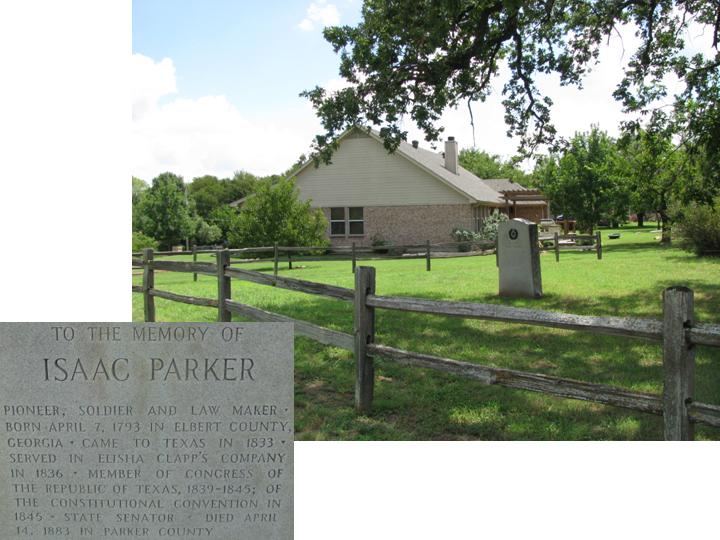
Isaac is said to have served in the company of Elisha Clapp during the Texas Revolution. Some articles may state that Isaac served in the Civil War, but at that time he would have been in his 60s. Accordingly, it does not appear likely that he would have served in any combat related position during those years, although he could have served in some local capacity. His son, Isaac Duke Parker, Jr. was born in 1821 and did serve in the Confederate Army during the Civil War. Isaac, Jr. also actively helped defend against Indian raids.
In addition to his connection with Cynthia Parker and the Parker family, Isaac Duke Parker is most often remembered for his political service. Parker began his long political career in Houston County by serving as a representative in the Texas Congress in its Third, Fourth, Sixth and Seventh sessions, spanning the years 1838 to 1843 with a one year break around 1840. He was then elected to the Texas Senate for the district that included Houston, Nacogdoches and Rusk counties in the Eighth and Ninth Texas Congress during the years 1843 to 1845 and was a delegate to the Convention of 1845, the convention that voted to accept the annexation of the Republic of Texas to become a state of the United States. After Texas became a state, Isaac served four more terms in the Texas legislature representing Tarrant and Ellis counties.
Parker was a key individual in submitting the 1855 petition of about 225 individuals in favor of creating Parker County, named for himself, out of the northern portion of Tarrant County. After approval of the formation of Parker County by the Texas Congress, Parker lived out the remainder of his years near Weatherford. He also said to have served as a judge for a time, though this is unconfirmed and definitely not to be confused with federal judge Isaac C. Parker who is unrelated to the Isaac Duke Parker family.
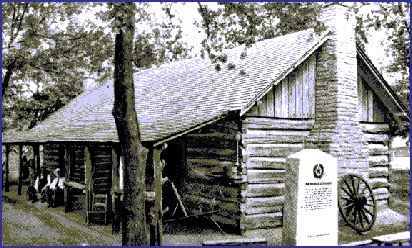
The community of Birdville, where Isaac once lived, was located east of Fort Worth and became part of it in the late 1900s. Parker’s 1848 Birdville cabin is historically significant and around 1960 it was removed to a location in Fort Worth known as Log Cabin Village, a collection of historic structures southwest of downtown. Parker’s cabin is built in the “dog trot” style and is thought to be the oldest surviving structure in Tarrant County.
Isaac died on April 14, 1883 at the age of 90 in Weatherford and is buried in Turner Graveyard there along with his widow Virginia and several other family members.
Isaac Parker’s former Birdville cabin, courtesy of Sarah Reveley:
© 2026, all rights reserved.

