“Tales of the Texas Rangers” refers to two programs which aired in media during the 1950s. The first was a radio program and the second was a television series.
The radio program: It was conceived as a weekly half-hour program to broadcast fictionalized stories pertaining to the former law enforcement agency. It was set in the 1880s and used scripts in a style that might be reminiscent of shows like “Dragnet.” Stacy Keach, father of actor Stacy Keach, Jr., was producer and director. Joel Murcott was the head writer of the series.
Keach (1914-2003) enjoyed a long career as an actor with numerous film and television appearances in his credits. Primarily known as a television actor, his appearances in television series began in the 1950s in early programs such as “Public Defender,” “The Lone Ranger,” “Sugarfoot,” “Tales of Wells Fargo,” “Bonanza,” on up to his more recent appearances in shows such as “Dr. Quinn, Medicine Woman,” “Dallas,” the Andy Griffin version of “Matlock,” “Falcon Crest” with his last credited appearance being “Mike Hammer, Private Eye.” He was married in 1937 to the former Mary Cain Peckham and the couple had two children, James Keach and Stacy Keach, Jr., both of whom became actors, directors and producers. Stacy, Sr. died in 2003 of a heart ailment.
Murcott (1915-1978) is primarily known as a writer for radio and television. His main radio credits included “Tales of the Texas Rangers” and “The Adventures of Frank Race” which was an adventure series in which the main character and a sidekick investigating and exposing business fraud. It ran for around 45 episodes between 1949 and 1952, roughly the same time period as the broadcast life of the Texas Rangers radio series.
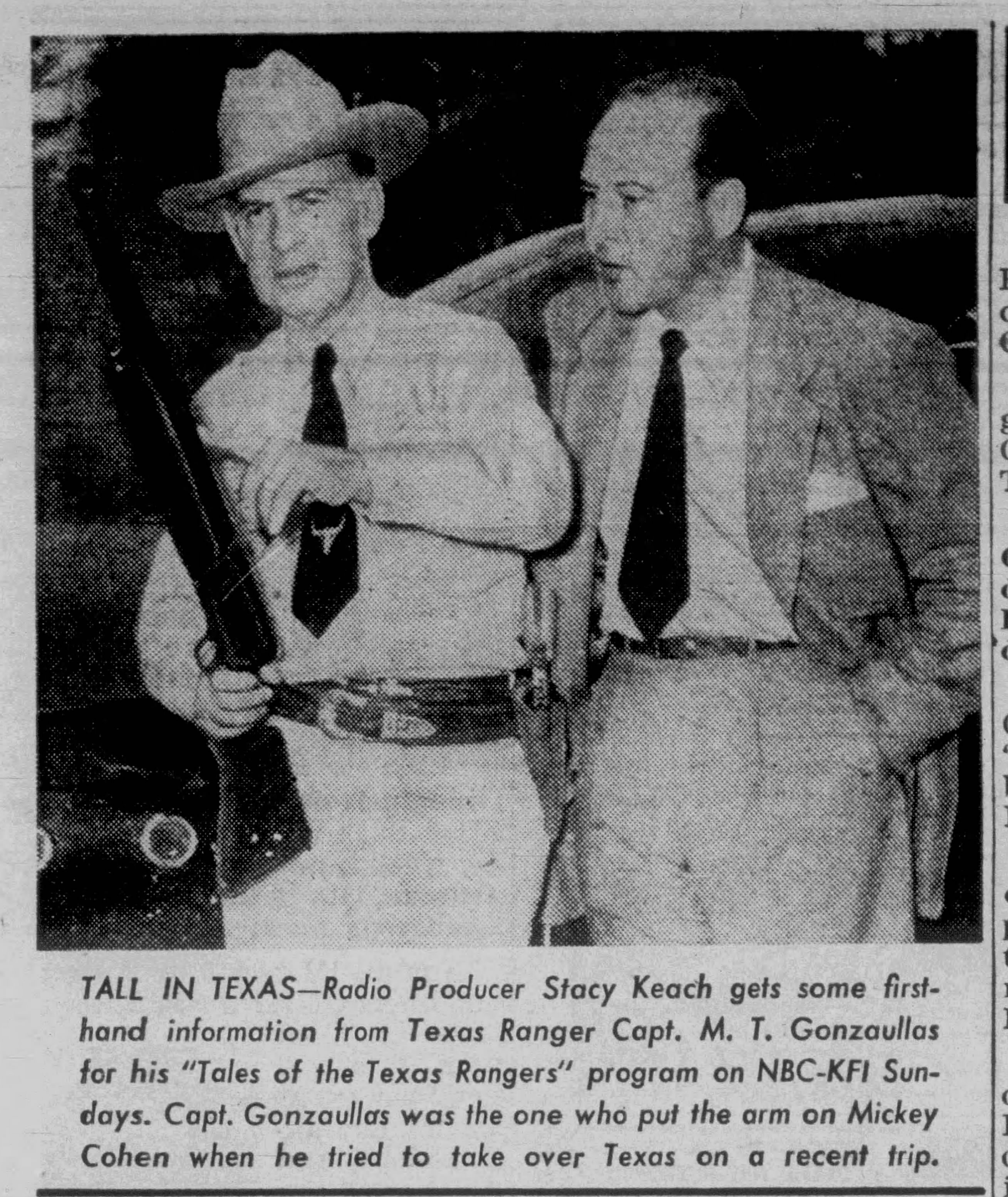
Write ups of the program say that the episodes were often based on current investigations that were adapted to the 1800s. The September 10, 1950 issue of the Fort Worth Star-Telegram posted a paragraph in its column “Radio Clock of the Week,” highlighting the new Texas Ranger series, already airing, noting that it was broadcast locally on WBAP radio and NBC every Saturday night at 8:30. The writer said that the series “will have a true Texas flavor this fall and winter” and noted that Keach and Murcott were currently in Texas gathering story material with Captain Manuel Gonzaullas of the Rangers as their guide. Gonzaullas was called a technical advisor.
About one month later, the October 17, 1950 issue of the Los Angeles Mirror gave a little more background. There the broadcasts were heard Sundays at 5:00 in the afternoon. It named Joel McCrea as the lead character, Ranger Jace Pearson. The writer called Keach the only outsider having access to Ranger records and that it had taken over a year of negotiation and several trips to Austin to make the agreement. It also noted that Keach had to submit scripts to Austin for approval and that the Ranger administration at that time did not care for trite expressions that might have been common in film and radio earlier, like “They went thataway.” Elsewhere, comments are noted that the cases made available to Keach and associates were from the 1920s to the 1940s.
An actor named Frank Martin played the part of Pearson in the “audition” or pilot episode before McCrea assumed the lead role. In addition to McCrea, there was a rotating ensemble of other actors, some of whom might play different roles from time to time. Some of the radio actors went on to television and/or film careers. One in particular was Hy Averback (1920-1997), a name that might have been familiar to early television viewers. Averback had some film and television acting credits but was likely better known as a television series director. His television directing credits included 20 episodes of the long running series “M*A*S*H,” 101 episodes of “The Real McCoys” and dozens of other shows.
The radio program aired from July, 1950 to September 1952. In all, it included the audition episode and around 95 more shows. It was in the category of western and police procedural drama. The audio files of the episodes can easily be found online.
The television series: After a few years, a television series began to air and in current terminology it would be considered a spin-off of the radio show. No single reason is noted why he was not used in the series, but by that time, McCrea had gone on to a long career in mostly western themed movies and stage appearances. Willard Parker was cast in the role of Pearson and Harry Lauter was cast as his second in command in the role of Clay Morgan. The series ran for three seasons and its 52 episodes aired between 1955 and 1959. Parker and Lauter appeared in all episodes. There were dozens of other actors who played different roles from time to time, but according to online databases, none of them appeared in more than five episodes. There were about a half dozen directors listed with Lew Landers having directed the greatest number of episodes. The writers numbered in the dozens with no single person credited for more than six episodes. Stacy Keach, Sr. was involved in more of a management role as producer and executive producer, though he is listed as one of the directors. Ranger captain Gonzaullas was once again involved as a consultant.
Willard Parker (1912-1996) was born Worcester Van Eps and got into acting as a young adult, appearing in westerns, science fiction and other projects during his career. He had appeared in numerous films since 1937 and several early television series before the Ranger program. “Tales of the Texas Rangers” was his longest running television role. Harry Lauter (1914-1990) was probably more recognizable. He had over 300 credits in film and television in many genres and was credited up into the mid 1970s. He appeared in so many series that his face might be familiar. Except for “Tales of the Texas Rangers” his television series appearances might be limited to one or two episodes each, although many were in long running series. He also appeared in films including one of the sequels to “Planet of the Apes.”
The Ranger series was unusual in that it had something of an unstated “time-travel” feature in which Parker and Lauter played lawmen during different eras, as early as the 1800s and approaching current day. Like the radio program, it was a product of the Screen Gems company. According to online databases, it was filmed in California. Episodes were also set to run about 30 minutes with commercials. They aired first on CBS and later moved to ABC. After the series ended, Parker and Lauter went on to other projects. Parker’s last credit was in 1966 and Lauter’s went on up into the late 1970s.
At this writing, the television episodes are much harder to find. The series is currently not legally carried on any of the more common streaming services, and is mostly available for purchase in the DVD format.
© 2026, all rights reserved.

