James Gaines was born in Culpepper County in Virginia in November of 1776. His parents were Thomas and Susana Strother Gaines. James was born Robert Thomas Gaines but later changed his name to James Gaines around 1810. He was a double cousin to Edmund Pendleton Gaines (two brothers married two sisters). Edmund’s parents were James and Elizabeth Strother Gaines. Edmund and James were born one year apart. They are both descended from James Henry Gaines and Mary Lillie Pendleton, whose ancestors had come from England to Colonial Virginia around 1650.
Pendleton was quite a familiar name in Virginia. Mary’s father was Henry Pendleton (1683 – 1721) and her mother was Mary Bishop Taylor. The family figured into the American Revolution and events around that time. Mary’s brother Edmund was said to be a personal friend of George Washington and a cousin of John Penn (of North Carolina, a signer of the U. S. Declaration of Independence and a member of the Continental Congress). Edmund is credited for writing the Resolution adopting the Declaration of Independence. One document notes that some of Edmund’s language was used almost verbatim by Thomas Jefferson in his Declaration of Independence. Another brother, John, married a cousin of future President James Madison. Beyond this generation, the Gaines family tree is somewhat confusing since some family names were used many times.
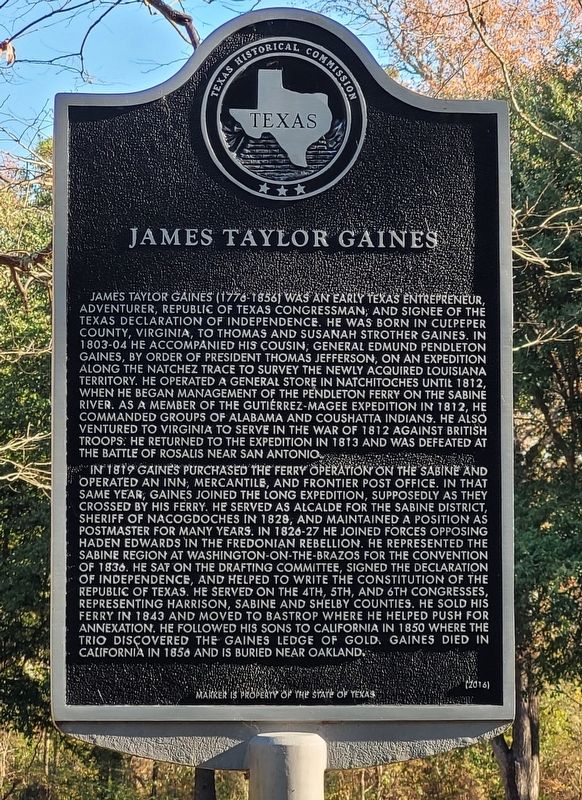
James worked with his cousin General Edmund P. Gaines for around two years beginning in 1803 during the presidency of Thomas Jefferson. They had been tasked with surveying land and waterways along the Natchez Trace. After several more years, he was said to have operated key ferry crossing the Sabine River by 1812. Shortly afterward, he is mentioned as a key organizer of the Gutiérrez-Magee expedition, an early effort against Spain during the colonial period. This is the same individual, José Bernardo Gutiérrez de Lara, who is known for leading opposition forces in the unsuccessful Battle of Medina. This defeat effectively ended the expedition. After the loss near San Antonio, Gaines went back to Virginia and fought against the British in the War of 1812. No biographical comments yet identify his regiment, though it is assumed that he served in some capacity in the Virginia militia before returning to Texas. By 1819, his name is associated with Dr. James Long who led filibuster campaigns into Spanish Texas.
His name comes up once more in 1819 when he acquired an existing ferry on El Camino Real, which he, his sons and their employees operated for over twenty years, bringing many colonists across from the United States to Texas. El Camino Real was a long major trade route and the exact location is not stated. However, given that for quite a few years, he lived in far east Texas on the Sabine River, the border between Spanish Texas and the United States, it was probably north and east of the existing town of Hemphill. In 1824, he served as alcalde (like a mayor) for the Sabine District of the Municipality of Nacogdoches, sheriff in Nacogdoches in 1828, and postmaster over a number of years. In addition to the ferry, he was known as a merchant and the operator of an inn. He later founded the settlement of Pendleton on this site. His settlement was most likely named after his ancestral family. Eventually all the residents drifted away and it is now a ghost town in Sabine County. For a time however, there were two Pendleton settlements. The other is an unincorporated community of the same name that still exists in Bell County.
Gaines was actively involved in support of Stephen F. Austin during the Fredonian Rebellion (roughly from late 1826 to early 1827) in opposition to Haden Edwards, its leader. It was a divisive time among the European settlers with some supporting Edwards and others, the majority, supporting the uneasy relationship with the Mexican government. It came only a few years after Mexico had won its independence from Spain and the relationship between Mexico and the settlers was already strained. Thus, putting town the rebellion somewhat helped the situation, though conditions were already leading up to the eventual Texas Revolution.
Gaines represented the Sabine area in the Convention of 1836. As such, he served on the drafting committee, he signed the Texas Declaration of Independence from Mexico and is said to have helped write the first Texas constitution. After the Republic of Texas came into being, he served as a senator in the Fourth, Fifth, and Sixth Texas congress, representing Shelby, Sabine, and Harrison counties.
Gaines sold his ferry operation in February of 1843 and resettled in Nacogdoches, where he was a strong proponent of the movement to have the Republic annexed as a state of the United States. He later moved to Bastrop where he operated another inn. The impact of “gold fever” affected many males around the mid 1840s, and the Gaines family was no exception. Gaines and two his sons left Texas around 1850 to look for gold. They founded a mine in Arizona. In the interim, his wife Susannah died. Gaines never returned to Texas, but his sons did.
Gaines was married three times. His first marriage was to Isabella Christian and they had one child, a daughter. His second wife was Katherine Vincent with whom he had two sons. He was married a third time to Susannah Norris and they had six children. Gaines died on November 12, 1856, two days before his 80th birthday, and is buried near Oakland, California.
Gaines is known to have personally seen to the construction of two residences, both made of pine logs. The first was for himself and his family and was said to be once located on a high hill within view of the ferry he and his family operated for so long. Oral tradition describes it as as a dog trot building from around 1815 having two large rooms separated by an open area. It had a second floor covering the two lower rooms. This structure was still standing in 1967 when Toledo Bend reservoir was being planned. This project was to have flooded the knoll where it sat. In anticipation of this, the house was dismantled and all the parts numbered. The intention was to reassemble it a little over two miles away. It was stored under tarps and sheets, but unfortunately the project was abandoned. The stored materials deteriorated and the residence was never rebuilt.
The second residence is believed to be an exact copy of his residence and dates from around 1815 to 1818. It was built for his third wife Susannah’s parents. It is now called the Gaines-Oliphant house. The Alfred Oliphant family acquired the home and 81 acres around it in 1843 from Gaines. The residence is now owned by the National Park Service, managed by the Daughters of the Republic of Texas and is listed in the National Register of Historic Places. It is one of a few pre-republic residences still standing.
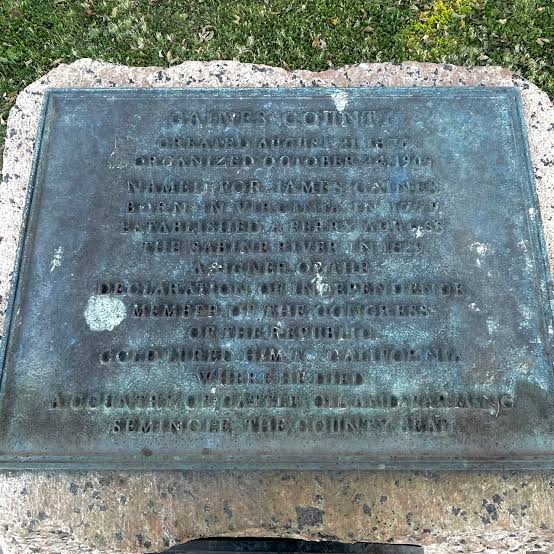
Gaines County was created in August of 1876 by the Texas legislature out of the Bexar Land District. It was formally organized thirty years later in 1905 with the town of Seminole as its county seat.
© 2026, all rights reserved.


One thought on “James Gaines, Namesake of Gaines County”