William Wallace Simpson might be one of the lesser known Texas illustrators, having worked primarily for North Texas newspapers for several decades. His many illustrations were added to articles. He was born July 8, 1880 in Shelby County, Illinois to William Laybourn Simpson and Sarah Jane Evans Simpson.
Wallace’s father had been born in England in 1844 and had come to Canada with his family in 1856. When William L. was about nineteen, he came to America, settling in Illinois. A great granddaughter told that they had moved to Texas around 1870. She added that William had participated in cattle drives including being one of sixteen cowboys on a drive that took 5,000 head of cattle from South Texas to Fort Laramie, Wyoming. In 1877, William L. married Sarah Jane Evans and they began to raise their family. When Wallace was born, his parents were in their thirties and his father was working as a farmer in Illinois. Wallace, as he was called, was the second child and oldest son of the couple. By the time the 1900 federal census was taken, the family was living in Childress, Texas, having moved there in 1892. Wallace was nineteen years old and the oldest of four children living at home. His father was operating a livery stable in town.
Wallace was known for liking to draw and sketch. He began working as a cowboy on ranches around his home. He worked on the 3-Bar and Buckle L ranches and studied art. As noted, he had discovered that he had considerable gifts as an artist. In a somewhat unusual turn of events considering his upbringing, Wallace decided to pursue his art interests and turned it into a career. It was said that he loved the cowboy life and used his deep affection for the lifestyle as the inspiration for his artwork. He married the former Effie Fields, whose family owned the Buckle L Ranch, on September 22, 1902. Their son Leroy Labon Simpson was born in Decatur in 1905. Effie had grown up in Decatur and the pair had met when her family sent Wallace in a buckboard to pick Effie up at a local train station. One article noted that Wallace would likely have enjoyed living the remainder of his life on a ranch, but that Effie was a “city girl” and preferred living in town to ranch life. Soon they moved to Fort Worth and Wallace took a job working for a livestock agent. He kept up his art and drawing and one of his engagements was to design stationary for a local company called Davis & Hamm Livestock Commission Company.
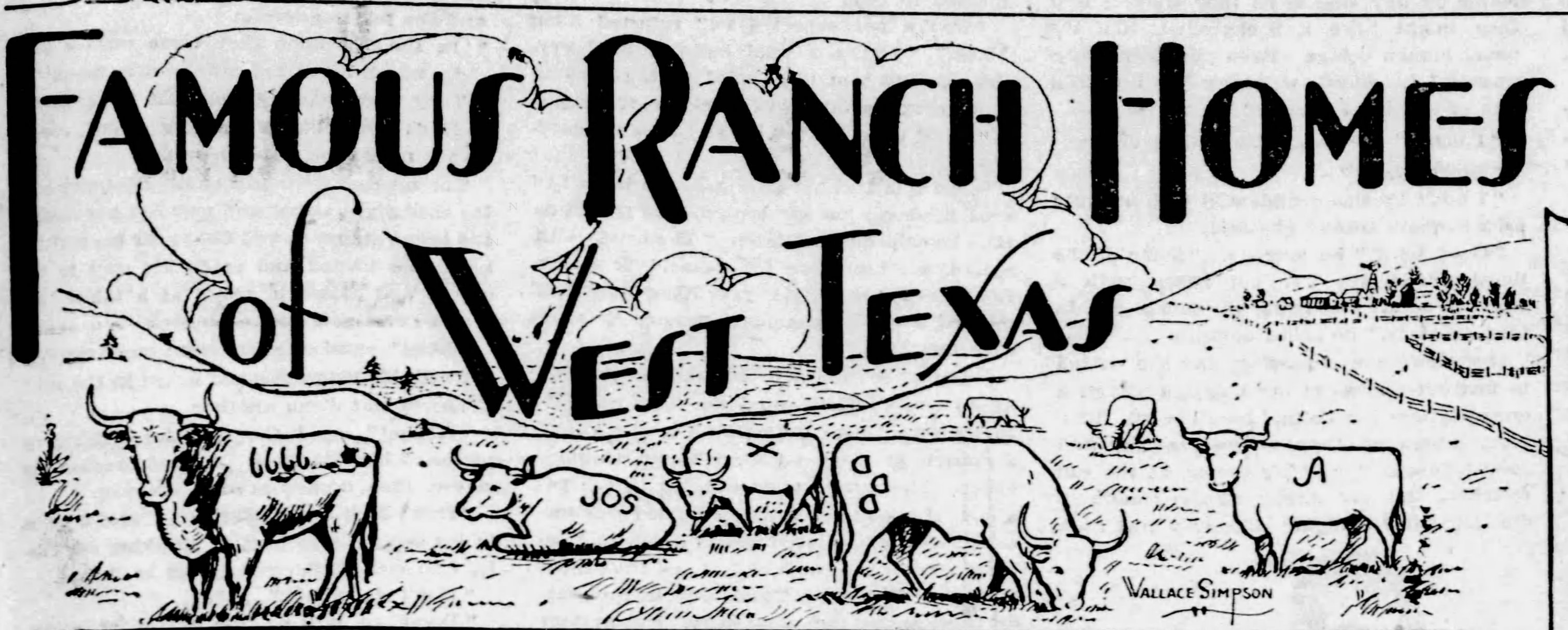
His first newspaper job was to work for $3 per week as an apprentice at Peerless Press in Oklahoma City around 1913. In 1914, they had moved to El Paso where he was working for the El Paso Times, having traveled with all their belongings to West Texas via stagecoach. After returning to Fort Worth, his work flourished at the Star-Telegram. The newspaper used his monochrome and color illustrations regularly. In addition to the annual stock show and rodeo, he illustrated articles about cattle drives, Texas personalities and an essay by the venerable Charles Goodnight. Wallace was also chosen to illustrate a 1926 series of articles by Walter Noble Burns entitled “Saga of Billy the Kid.” The newspaper had secured an agreement with the author to publish excerpts from Noble’s book of the same name in serial form. Below is Wallace’s banner illustration accompanying a long article about headquarters houses of some of the well known ranches of West Texas. His characteristic signature appears in the lower right between cattle bearing the Waggoner and JA brands.
Where the family lived over the years: In the 1910 federal census, Wallace’s profession was listed as designer for a paper company and the couple was living in Oklahoma City. By the time the 1920 census was taken, they were residing in Fort Worth. His profession was listed as artist and presumably he was by that time working for the Star-Telegram, though the “industry” category is illegible on the census form. The 1930 census form was much the same, listing his job as “artist,” except at that point, he listed his workplace as “studio.” In the 1940 census they were living in Sapulpa, Oklahoma. The Simpsons had moved there around 1936 on land that his family had acquired from Chief Billy Sapulpa. He ran some cattle while living there. Wallace was director of an art gallery in a public library. Biographical information also notes that while in Sapulpa, Wallace also did artwork used on milk bottles for Liberty Glass Company. The family returned to Fort Worth in 1952.
In 2004, the Texas Cowboy Hall of Fame exhibited forty of his sketches and illustrations in connection with the 108th Fort Worth Stock Show and Rodeo. In a Star-Telegram article about the exhibit, the art curator of a West Texas museum referred to Wallace’s work as being “rather naive” and quickly added “but that made it charming and honest.” He described Simpson as being one of a small group of artists who documented the cattle industry of his day, also one of a select few who had an interest in cowboying. Further, he referred to Simpson as “a cowboy who happened to paint, not a painter who tried his hand at cowboying.”
After Wallace died in Decatur in 1956, the article added, most of his art was stored in a family attic. Many years later, a granddaughter began looking through the collection, framing and preserving it. The collection caught the eye of the president of the North Fort Worth Historical Society after which interest in his work began to grow. All of this led to Wallace’s 1928 stock show artwork being selected to highlight the 2004 exhibit. Wallace had been chosen to illustrate the 1927, 1928, 1929, 1933 and 1934 programs for what was then called the Southwestern Exposition and Fat Stock Show. In 1930, one of his duties for the stock show was to serve as director of the exposition’s western themed art show featuring local and other artists.
Simpson’s honors include being inducted into the Texas Trail of Fame in 2008. Other honorees that year included Buck Taylor, Randolph Scott, Larry McMurtry, Clara Driscoll, Mirabeau B. Lamar and the American buffalo. The Texas Trail of Fame is located in Fort Worth and its mission statement states that it was established “to honor those individuals, organizations, groups and animals who have made a significant contribution to our heritage, traditions, set of values, and dedications to the preservation and perpetuation of the Western way of life.”
Wallace Simpson died in Fort Worth on December 17, 1956 at the age of 76. He was survived by his wife Effie, their son Leroy, two grandchildren and three great grandchildren. After a funeral service at a local funeral home, he was buried in Oak Lawn Cemetery in Decatur. Effie followed him in death in 1967 and is also buried there in Decatur.
© 2026, all rights reserved.

