William Gordon Cooke is considered a hero of the Texas Revolution. He was born in Fredericksburg, Virginia on March 26, 1808 to Adam G. Cooke and Martha Riddell Cooke, both of whom were Irish natives. William was the youngest of their three children. A daughter, Jane Oliver Cooke, died at sea around 1792, as the couple was on their voyage to America. Their first son James was born in Virginia and William was the youngest. James became a doctor. After completing his formal education, William moved to New Orleans where he was engaged in the drug business. There he became associated with the New Orleans Greys.
The Greys were a privately funded organization, a militia, created in the fall of 1835. The initial funding was mostly provided by two Louisiana businessmen and augmented by local citizens sympathetic to the cause of the Texas Revolution. An estimated 120 individuals (subdivided into two companies) joined the unit which came to Texas and participated in most of the major events including the Siege of Bexar, the Alamo and Goliad. They were largely decimated by the time of the Goliad event in late March, 1836 but are honored for having volunteered and for their bravery.
Cooke landed with his company at Velasco in mid November, 1835 and was elected First Lieutenant. Within a few weeks, the Greys had joined the Texas forces at Bexar where he was elected Captain. They were serving under the Texas units and not as an independent force. Texas units had been on site since about the second week in October. Accounts mention that the Texas troops were in somewhat of a disarray with differences of opinion as to the potential success of the effort. Nevertheless, the Texas forces rallied to take on the Mexican army billeted there and were successful. General Martin Perfecto de Cos and Mexican forces surrendered around December 9, 1835.
Soon afterward, some of the New Orleans volunteers elected to return home and were honorably discharged in January, 1836. Cooke and the remaining Greys participated early in the Matamoros Expedition. The Texas forces had been successful early on in driving out the Mexican army and planned an attack to try and take the Mexican port of Matamoros, an idea which had been discussed for some time. Sentiments were divided with some feeling it was possible while others felt it was too risky. The expedition began in late January with around 200 men under James B. Fannin, counting on additional support from Federalists who opposed Mexican Centralist leader Santa Anna. On the strength of the expected Mexican Federalist support, Cooke was reassigned to San Patricio in support of other forces there. Reasons for the failure of the effort generally include the following. The provisional Texas government was not united behind the plan, supplies were inadequate and the number of available forces was less than expected. Further, Mexican forces behind the Centralist government executed surprise attacks on Texas forces, which effectively routed the separated combatants before an attack could be mounted.
Cooke was elsewhere when some of the Greys (around two dozen) were sent to the Alamo. All of them were lost. He was also serving with Sam Houston at Washington-on–the-Brazos at the time of the Goliad Massacre. Cooke continued to serve under Houston and held the rank of Major at the Battle of San Jacinto. At San Jacinto he was said to have been the person who carried Houston’s staff member and surgeon general, Dr. Motley, off the field when he was wounded. He was also reported to have been in charge of prisoners, including the captured Santa Anna, and is credited with preventing others from taking the life of General Santa Anna. The general was despised for his various command decisions, including the execution of captured Texas prisoners at Goliad and his harsh treatment of captives on other occasions. After San Jacinto, Cooke accompanied Houston to New Orleans for treatment of his wounds.
These are the offices that Cooke held in the early days of the Republic. In 1837 he was quartermaster general and inspector general of the army. In 1838 he was stock commissioner presiding over the issuance of securities for the payment of debts of the Republic. He resigned his commission for a while, possibly due to poor health, and for the next two years he was called to head the commissary of subsistence. Upon his return, he was shown to hold the rank of colonel if the First Regiment of Infantry in 1840. In March of that same year, he was serving as commissioner after his appointment by President Lamar and was authorized to sign treaties with the Comanches at the time of the Council House Fight in San Antonio.
In the summer of 1840, he was assigned to map out a military road to the Red River. Some accounts have him personally establishing two forts, one of which was called Fort Preston on the banks of the Red River. Though it may be doubtful that he personally made it that far to the north, it is possible that he reached as far as what became Dallas County a few years later.
Conflicts with Mexico did not entirely end after 1836. For about ten years, there were numerous clashes over the disputed borders between Texas and Mexico. Also under President Lamar, the area Mexico still controlled to the west was appealing as a target for future Texas expansion.
As a civilian, Cooke was appointed civil commissioner of the 1841 – 1842 failed Santa Fe Expedition under Republic of Texas President Mirabeau B. Lamar. This was an effort to occupy New Mexico while it was still under the control of Mexico. Survivors of the expedition were imprisoned in Mexico for a number of months. One of the terms of his release was that Cooke had agreed not to again take up arms against Mexico.
Cooke is mentioned as having participated in countering Mexican general Adrian Woll who had come in September of 1842 with over 1,200 Mexican soldiers in an effort to retake San Antonio. Afterward, Cooke served as quartermaster general during 1841 and 1842. He rejoined the Texas Militia and participated in the Mier and Summervell expeditions. He was elected to serve in the Texas congress in 1844 representing Bexar County. In 1845, he served as secretary of war and the navy under Republic of Texas President Anson Jones. Cooke was unsuccessful in his campaign to serve in the United States Congress after Texas joined the Union in 1845. He served as adjutant general of the state militia in 1846 and 1847 under Texas Governor James Pinckney Henderson.
Cooke was a Protestant and a longtime member of the Masonic Lodge. He had married the former Angela Maria de Jesus Blase Navarro, a niece of Jose Antonio Navarro, on August 16, 1844. The couple had one son, William Navarro Cooke, in 1846. Their relationship ended with Cooke’s death from complications of tuberculosis late December, 1847. Cooke was first interred at Geronimo before being reinterred in the Republic Hill section of the Texas State Cemetery in 1939.
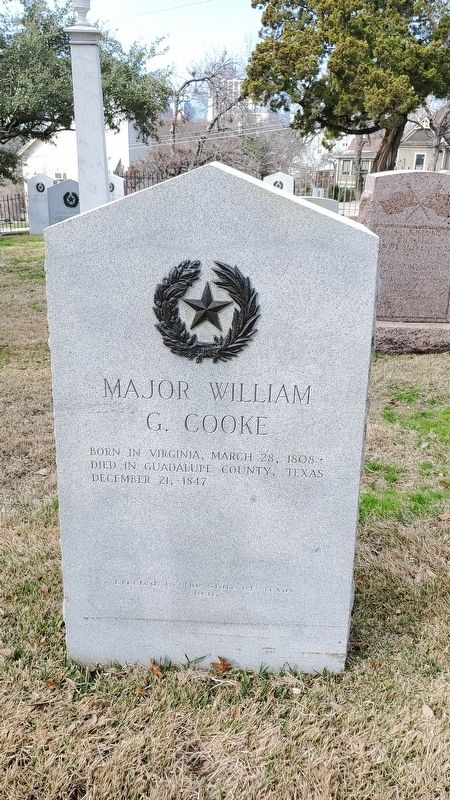
In 1848, a few months after his death, Cooke County was created from a portion of Fannin County. It was formally organized one year later on March 10, 1849.
© 2026, all rights reserved.
 Texas History Notebook