John B. Denton is the namesake of Denton County and the town of Denton. There has been some question regarding what his middle initial stood for. His middle name has variously been shown as “Bernard,” “Bunard” or “Bunyan” but the wife of a descendant said that his middle name was “Bunyan.”
Denton was born in Sparta, Tennessee on July 28, 1806 to James Denton and Sarah Clarkson Denton. He was the oldest of about eight children. Some accounts say that he was orphaned around 1815, but his father and mother are believed to have died in 1827 and 1846, respectively, according to current genealogical information available. Other accounts suggest that Denton ran away from home as a young boy and held various jobs including apprenticing as a blacksmith and working on steamers on the Mississippi River. For whatever reasons, he was residing in Arkansas when he was marred on June 23, 1825 to the former Mary Greenlee Stewart. The couple started their family with the birth of the first of their children the next year.
His wife Mary is credited with helping him learn to read. From that point, he was self educated and became a Methodist minister in the mid 1820s. For the next 10 years or so he was a traveling preacher in Arkansas and Missouri for the Methodist Episcopal Church. Denton and his young family came to North Texas after 1836.
The following incident was reported in the February 3, 1957 issue of the Denton Record-Chronicle. The article stated that the real “and almost unknown” reason for the family leaving Arkansas was due to a murder trial of Mrs. Denton. The couple had separated for a time due to some family disagreement and Mrs. Denton had moved to Fayetteville to set up a millinery shop. Living as a single woman, she was in her room one night when a local merchant, described as “a man of wealth and influence,” tried to enter her room. She refused and he broke the door down. Mrs. Denton was armed with a gun and shot him, leading to his death. She was indicted for murder and put in jail. The day of the trial came and Mrs. Denton had no defense counsel. Her husband was in the court room and volunteered to defend her. The trial proceeded and Rev. Denton was said to have done a stellar job in her defense. Mrs. Denton was found not guilty of murder. The article concluded by referencing a previously published account of the trial from a Clarksville newspaper.
The family’s relocation to Texas was said to have been influenced as well by a fellow Methodist minister, Rev. Littleton Fowler, who was preaching in East Texas. Rev. Denton was described as being a natural orator. Once in Texas he began to serve as an itinerant minister as he had done in Missouri and Arkansas. After some time, apparently frustrated in his desire to establish a similar ministry in Texas, he began his legal profession in Clarksville, Red River County, in Texas. He was called one of the leading lawyers in Clarksville and for a time was the law partner of Edward H. Tarrant. Denton also was interested in politics and was defeated in what was called a bitter campaign to Robert Potter, also of Clarksville, for a seat in the Texas senate.
Rev. Denton had joined the Texas militia in 1839, earning the rank of captain. He was one of around 70 members of a company of the Texas Militia organized by Captain E. H. Tarrant to defend settlers against raids from various Native American tribes in North Texas. The group had been responding to deadly attacks across the area over the years. At least one fatal attack had occurred in Clarksville. As an aside, several members of Tarrant’s company went on to have Texas counties named for them including W. C. Young, Daniel Montague, William Cooke and Tarrant himself.
The account of the incident in which Denton died was retold by Mrs. Annie Baker of Corpus Christi, the wife of Denton’s grandson, as Mrs. Baker was being interviewed for a newspaper article. Mrs. Baker said that she had personally spoken with Rev. Andrew J. Davis, a former member of Tarrant’s company. In the spring of 1841, the troupe had been riding through the frontier beyond Fort Warren, Fort Graham and Bird’s Fort coming across occupied and abandoned Indian camps. One account says that on an occasion in May of 1841, they came across a Keechi village that had as many as 200 dwellings and an estimated 1,000 defenders. The encampment was located in what is now Tarrant County. The company attacked the village in an incident that became known as the Battle of Village Creek, inflicting a few fatalities as the inhabitants dispersed. After calling the scattered troops together, the group took an inventory that included a half dozen head of cattle, around 37 horses, pounds of lead, powder and bullets.
Scouts reported several trails leading away from the camp. Denton and at least two other men were assigned to follow one trail. Mrs. Baker said that on May 24, 1841 as they were riding on one side of a creek, they they spotted a band of warriors on the other side. As he was raising his rifle to fire, Denton was fatally wounded by a arrow that passed through his body. Rev. Denton was the only fatality. Several others in the party were wounded but were able to escape. The warriors dispersed and his fellow militia members remained at the site long enough to recover Denton’s body before taking it to a safer location where they could bury him. To prevent anyone else from recovering Denton’s remains, they dug up turf and placed it on the grave.
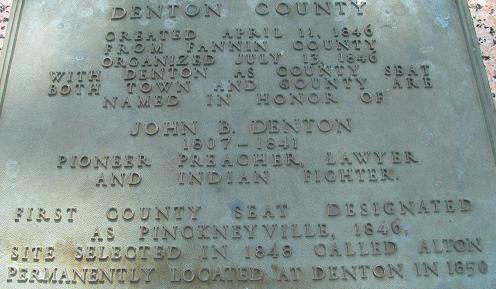
Denton and his family had resided in Clarksville for some time and residents were deeply affected by news of his death. His story continued to circulate and five years later on April 11, 1846, the Texas legislature voted to name a new county in his honor.
The same February 3, 1957 issue of the Denton Record-Chronicle suggested in another article that Denton had been buried three times. The first burial was as described above and located beside a creek. Some time later, cattleman John Simpson Chisum recovered the remains and transferred them to his Texas ranch. Chisum’s father Clabe had been a member of Tarrant’s company.
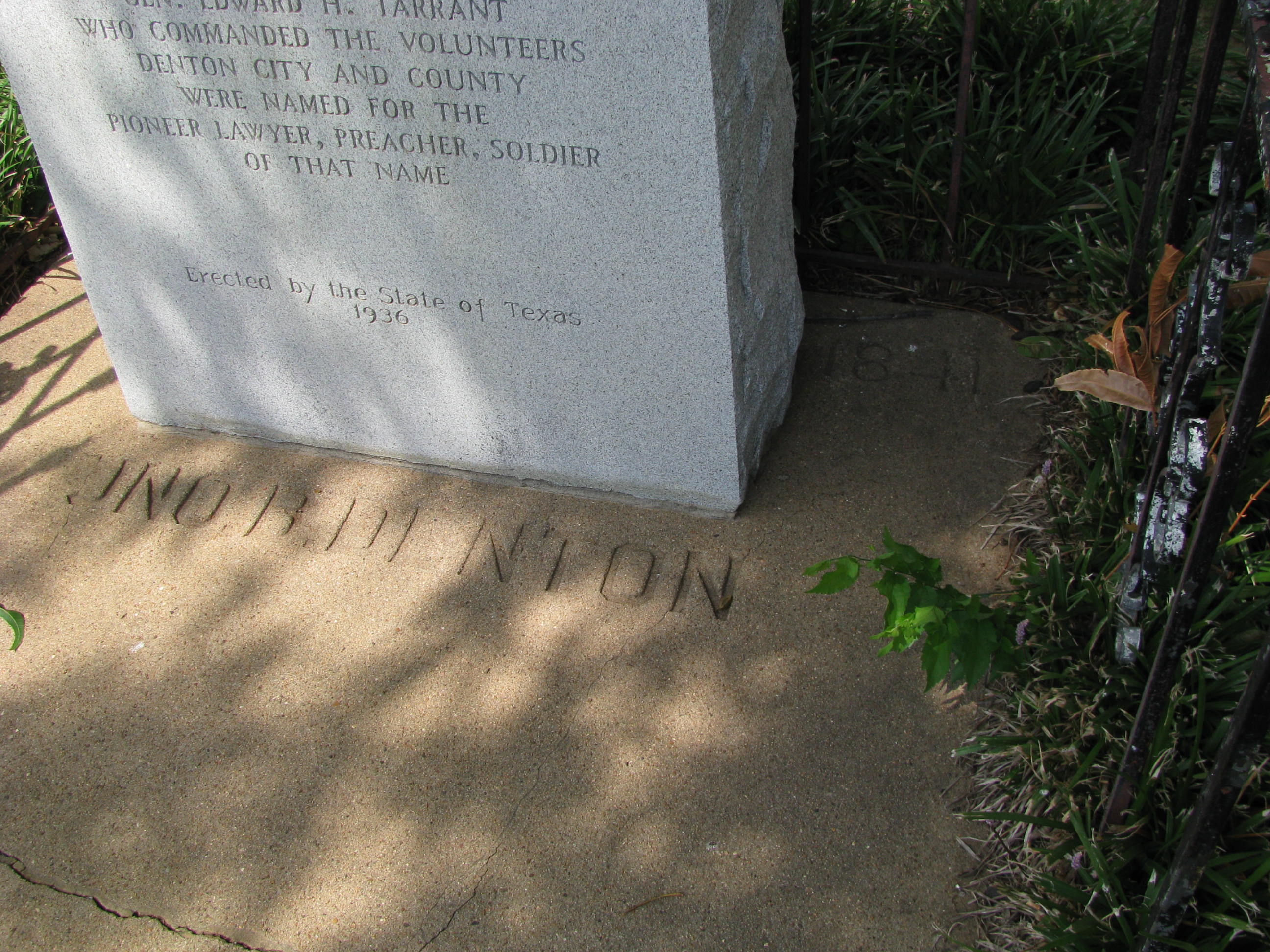
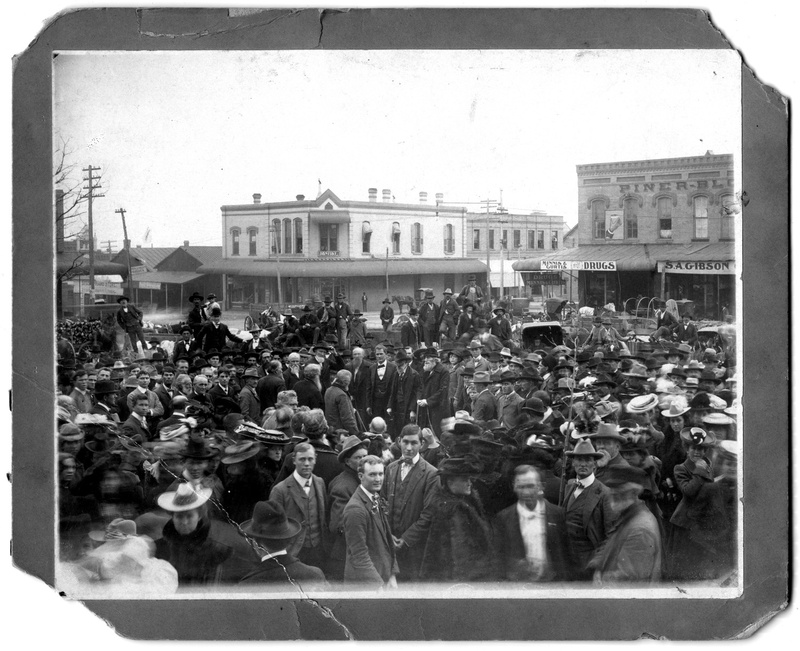
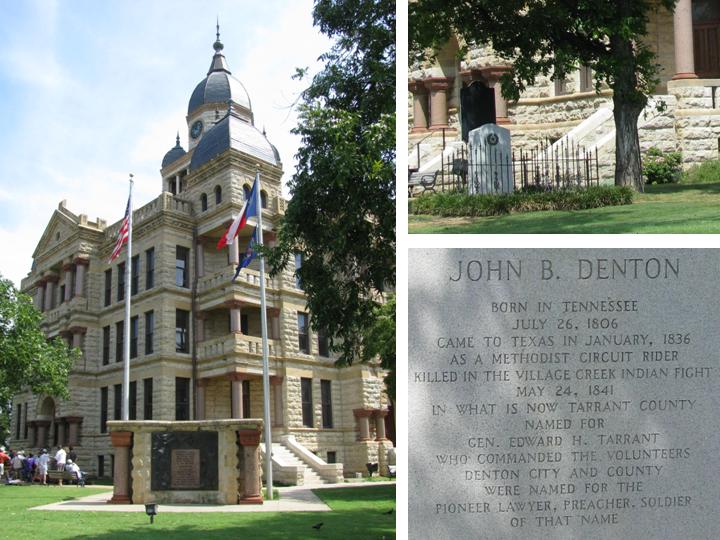
Finally, in late November of 1901, his remains were reinterred to his final location outside the Denton County courthouse, sponsored by a group called the Old Settlers Association. A formal ceremony was held. It began in the District Court room with 600 or more people in attendance, including several early settlers and a number of Rev. Denton’s descendants. We understand that there are inscriptions that date back to the time of this ceremony. 35 years later in connection with the Texas Centennial, a granite marker was installed which reads as follows:
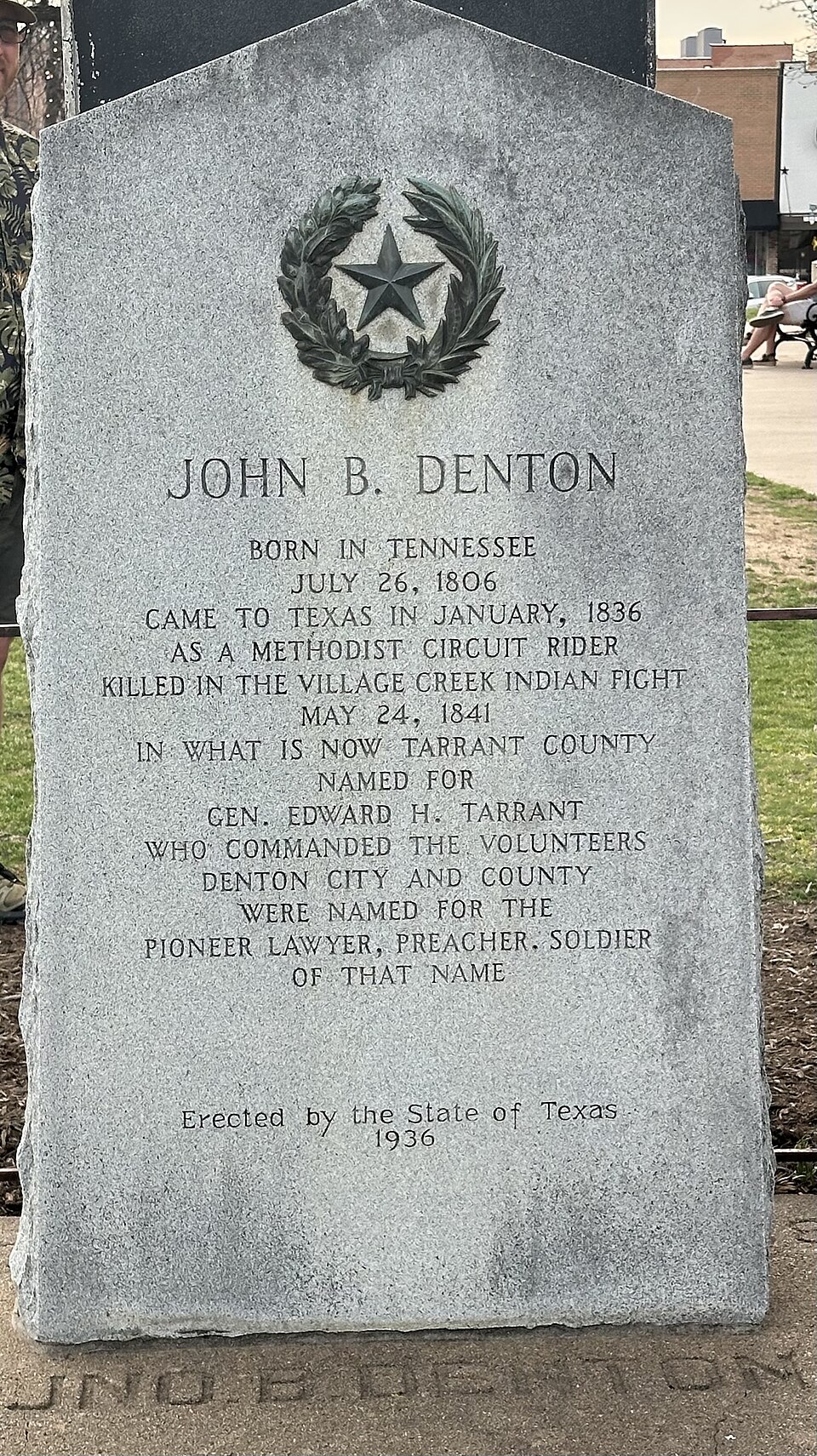
Born in Tennessee
July 26, 1806, came to Texas in January, 1836
As a Methodist circuit rider
Killed in the Village Creek Indian Fight
May 24, 1841
In what is now Tarrant County
Named for Gen. Edward H. Tarrant
Who commanded the volunteers
Denton City and County were named for the
Pioneer lawyer, preacher, soldier
Of that nameErected by the State of Texas 1936
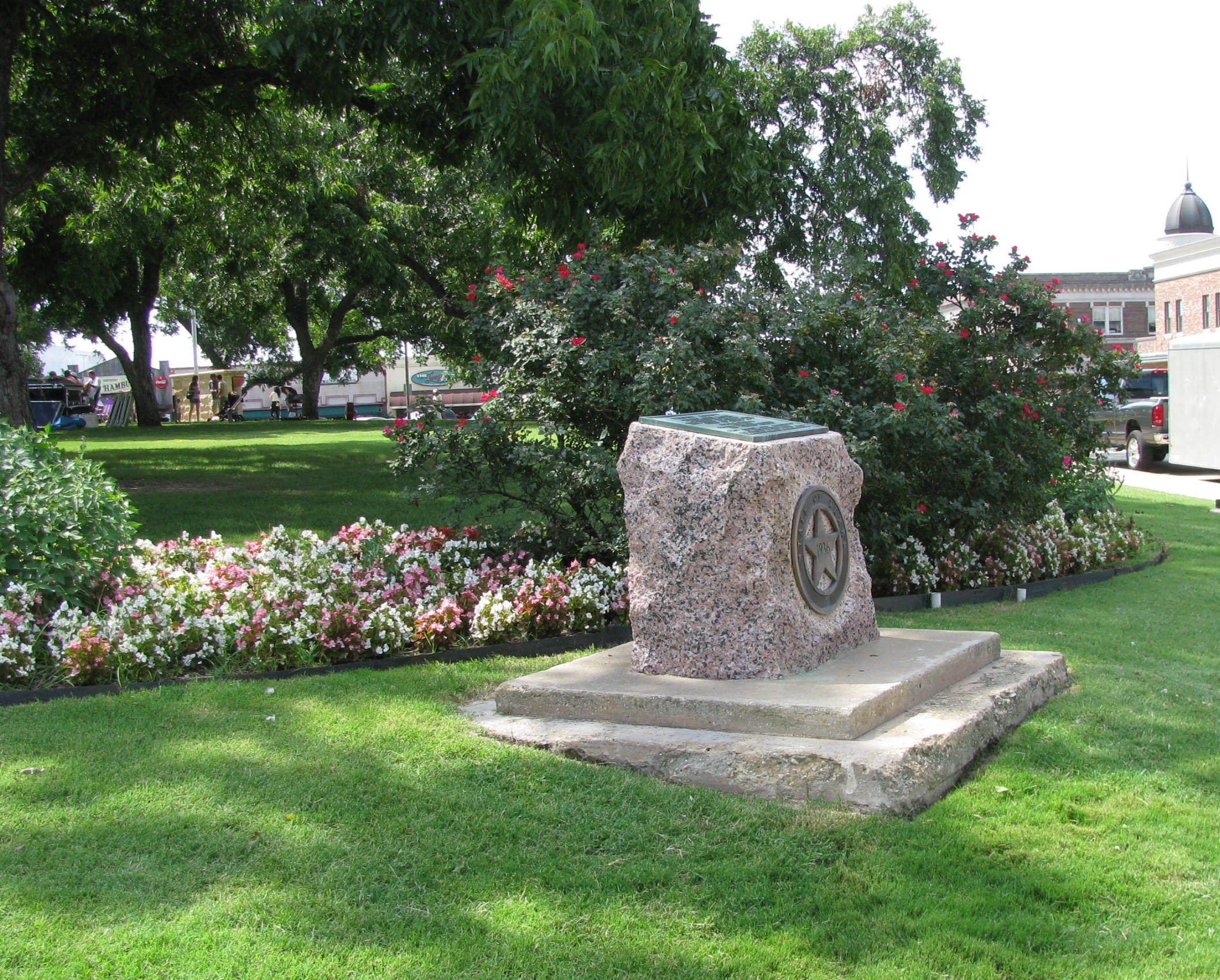
Images courtesy of Sarah Reveley:
© 2026, all rights reserved.

