Cowboy Strike of 1883 and the Ghost Town of Tascosa

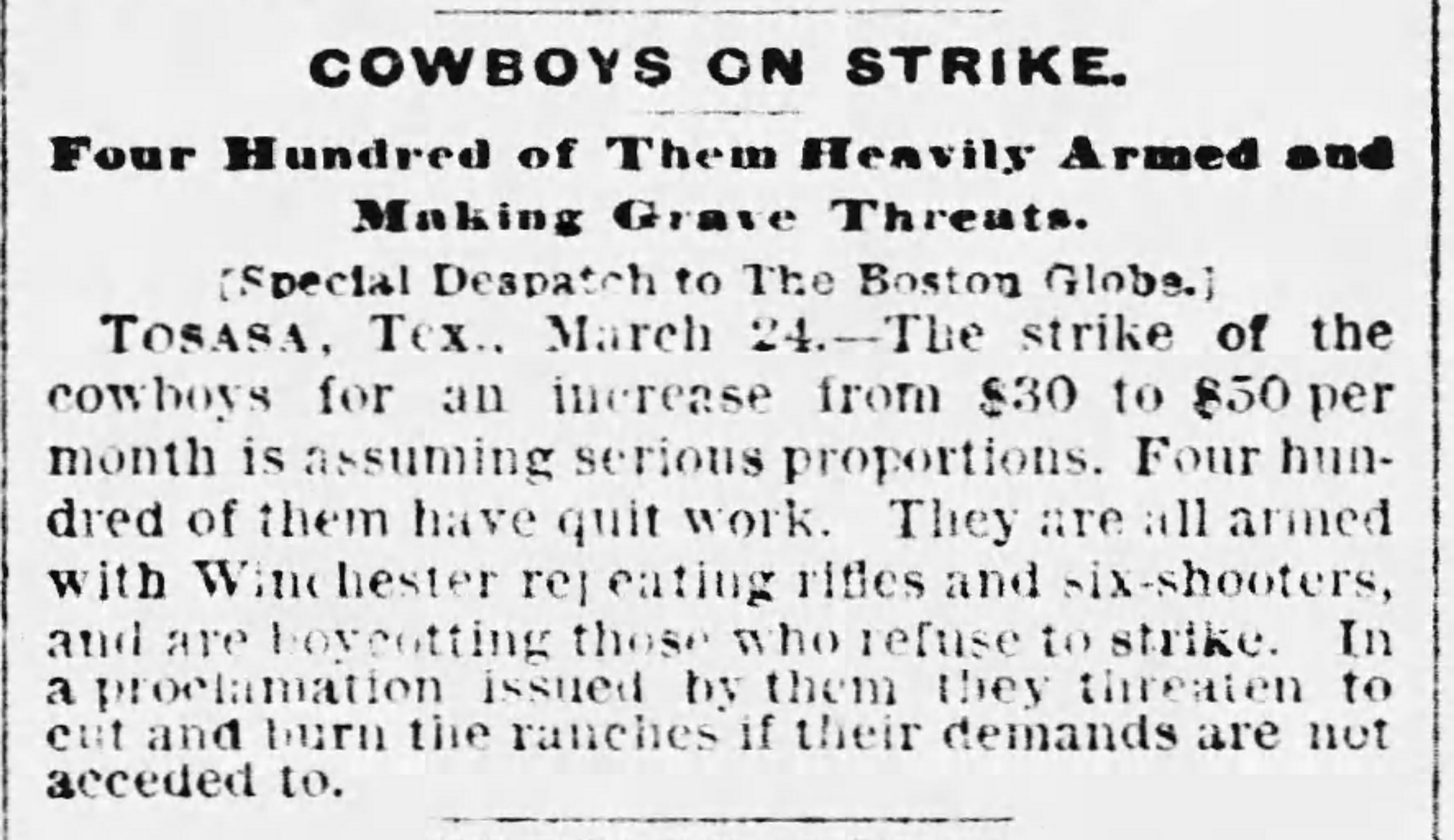
Image credit: Boston Globe, Marcy 24, 1883

In the spring of 1883, the newspapers like the Boston Globe reported that hundreds of cowboys went on strike for higher wages. The next day, a Wyoming newspaper gave more details, repeating the $50 per month demand. This article alluded to the possible threats of danger facing cowboys who declined to participate in the strike, but gives the number of strikers to be two hundred. Both have typographical or transcription errors. “Tosasa” in the Boston Globe article is probably a misspelling of Tascosa. The Wyoming article calls the county of the strike “Lascasa” and places it near the Texas-New Mexico border. The articles begin to settle down in a few days and give the location to be Tascosa.

Continue reading Cowboy Strike of 1883 and the Ghost Town of Tascosa

John Robinson Ralls

The October 27, 1921 issue of the Lubbock Avalanche carried a front page article with the headline “Funeral of John R. Ralls Attended by a Large Concourse of Friends From All Over the State.” It was held in the town of Ralls, Texas, about thirty miles east of Lubbock on Highway 82. The number of attendees was “into the thousands,” the article added and noted that friends came from Texas, New Mexico and Oklahoma to pay their respects.

Continue reading John Robinson Ralls

Mobeetie, Texas

Mobeetie is generally considered to be the first town to arise and also remain in the Panhandle of Texas. It now is located in Wheeler County. Its origin dates back to the mid 1870s when trading in buffalo hides was economically profitable. Trails were established where traders from northern states including Kansas would interact with buffalo hunters. The settlement that sprang up became known as Hide Town or Hidetown.

Continue reading Mobeetie, Texas

Gay Hill, Texas

Though perhaps not as familiar a name as either Independence or Washington, there is a great deal of Texas history that is connected to the former residents of this small community. Gay Hill was named for Thomas Gay and William Carroll Jackson Hill. Gay and Hill were said to have been store owners in this Washington County settlement, though some accounts say that only Hill owned the store. The settlement was originally known as Chriesman Settlement after Horatio Chriesman (1797-1878).

Continue reading Gay Hill, Texas